Friday, 13 May 2011

In the South of France: Eze Village, Eze

Eze is one of the most picturesque places to visit in the French Riviera. Its main tourist attraction is the Eze Village, a medieval walled city. This village was once occupied by the Romans , then, subsequently by the Moors, who were driven out by William of Provence in 973. It continued to have a turbulent history. In 1388, it was under the House of Savoy, then, the French and the Turks seized the village under orders from Barbarossa in 1543. In 1703, in came Louis XIV's order to destroy the village, for reasons unbeknownst to others, in the War of Spanish Succession.  Finally, the people of Eze decided to have their territory become a part of France in 1860.

Bound by the coast line on the Mediterranean Sea and all the way to the top by a natural forest, and from Cap Roux to Cabuel point, it's a peaceful place to be when you want to get away from the city life. Eze is right next to Nice, about 30 minutes away from the Côte D'Azur airport.
It's a magnificent view from the natural forest which is accessible via the Grand Corniche (translated as "grand ledge" which is the high coastal road).  Here, our senses are awakened with the panoramic views of the sea, the beautiful natural landscape, and the high winds that make you sway.
There is a view deck - the perfect place to see Eze and the other surrounding villages.  
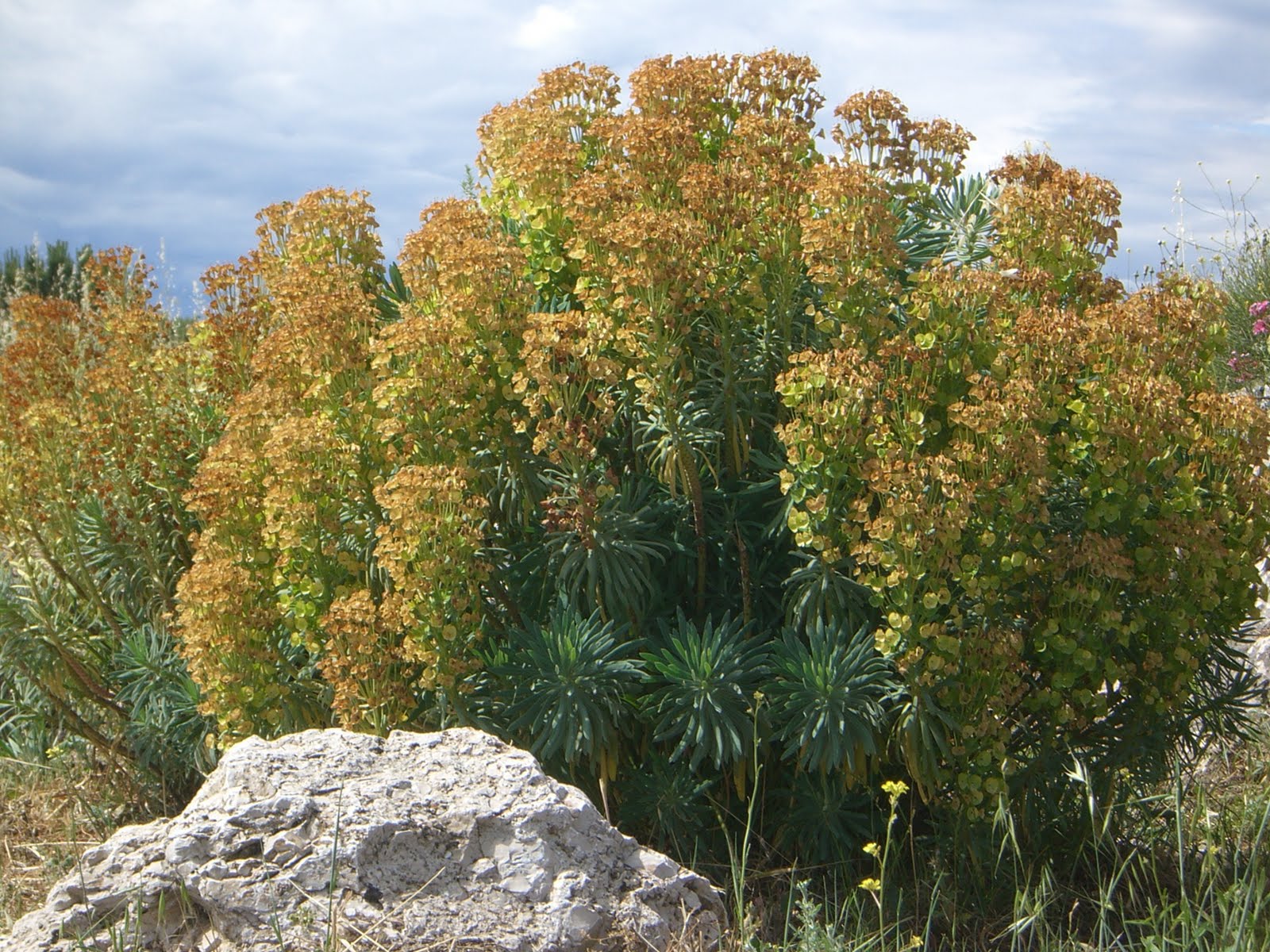
 It's a botanical garden of sorts, of wild plants and flowers. This looks like a flaming shrub from afar.
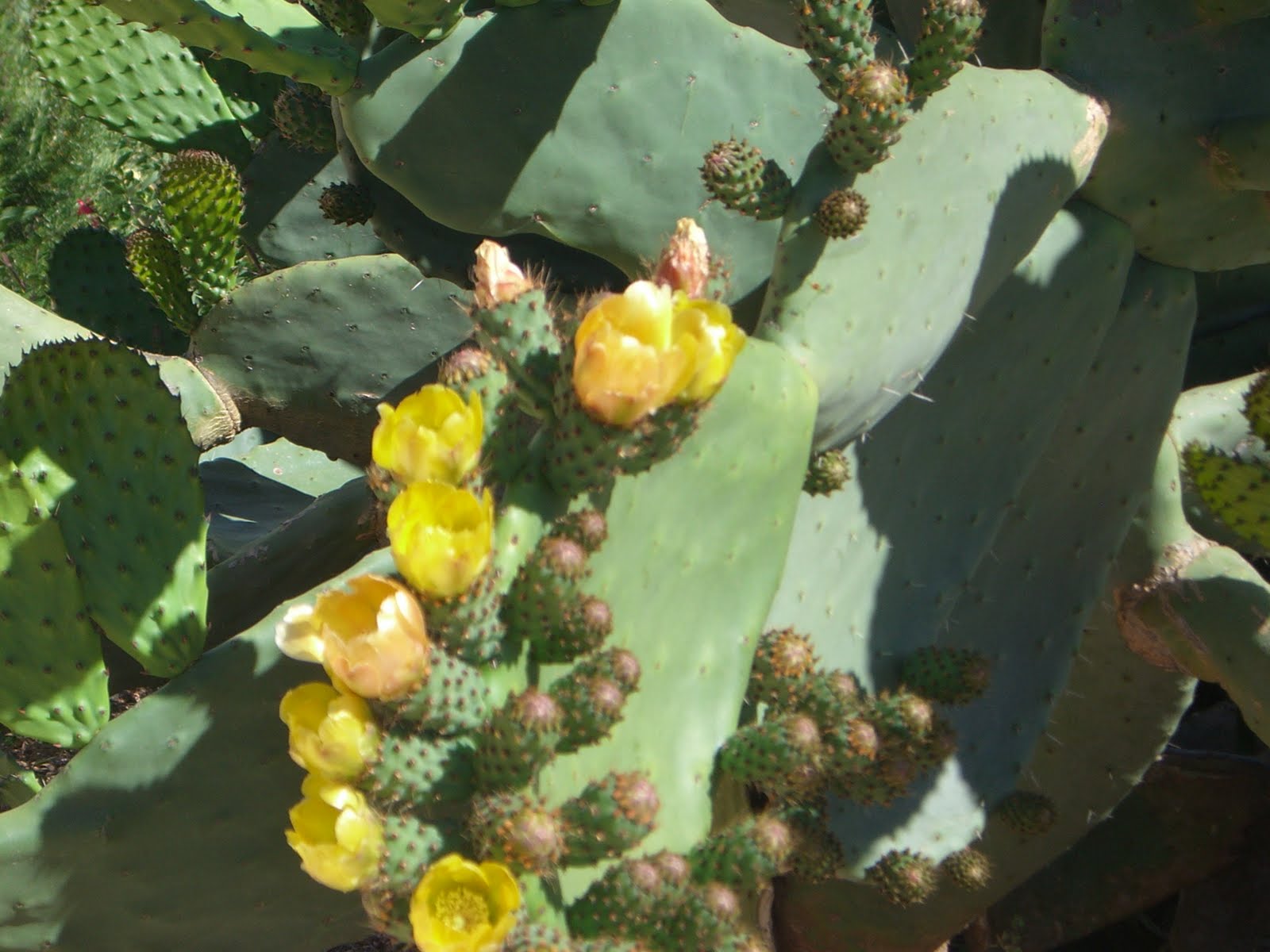
A fruiting cactus - prickly Barbary pears - full of seeds but sweet tasting.
A blooming cactus - Agave, which dots the hills here and there. The mistral wind is in the background - it is accompanied by clear and fresh water, and in part, is the designer of  the climate in Provence. It blows during the winter and spring seasons, but is present all year round.

The hillside is lush and the houses and condominiums that are situated on the hilly slopes are, almost always, afforded a view of the sea.
On a clear day, boat watching on the Mediterranean Sea - where the ships and yachts, commercial and privately owned - sailing through, can be rather entertaining, especially when you know who the personalities are in the yachts - like Paul Allen of Microsoft.
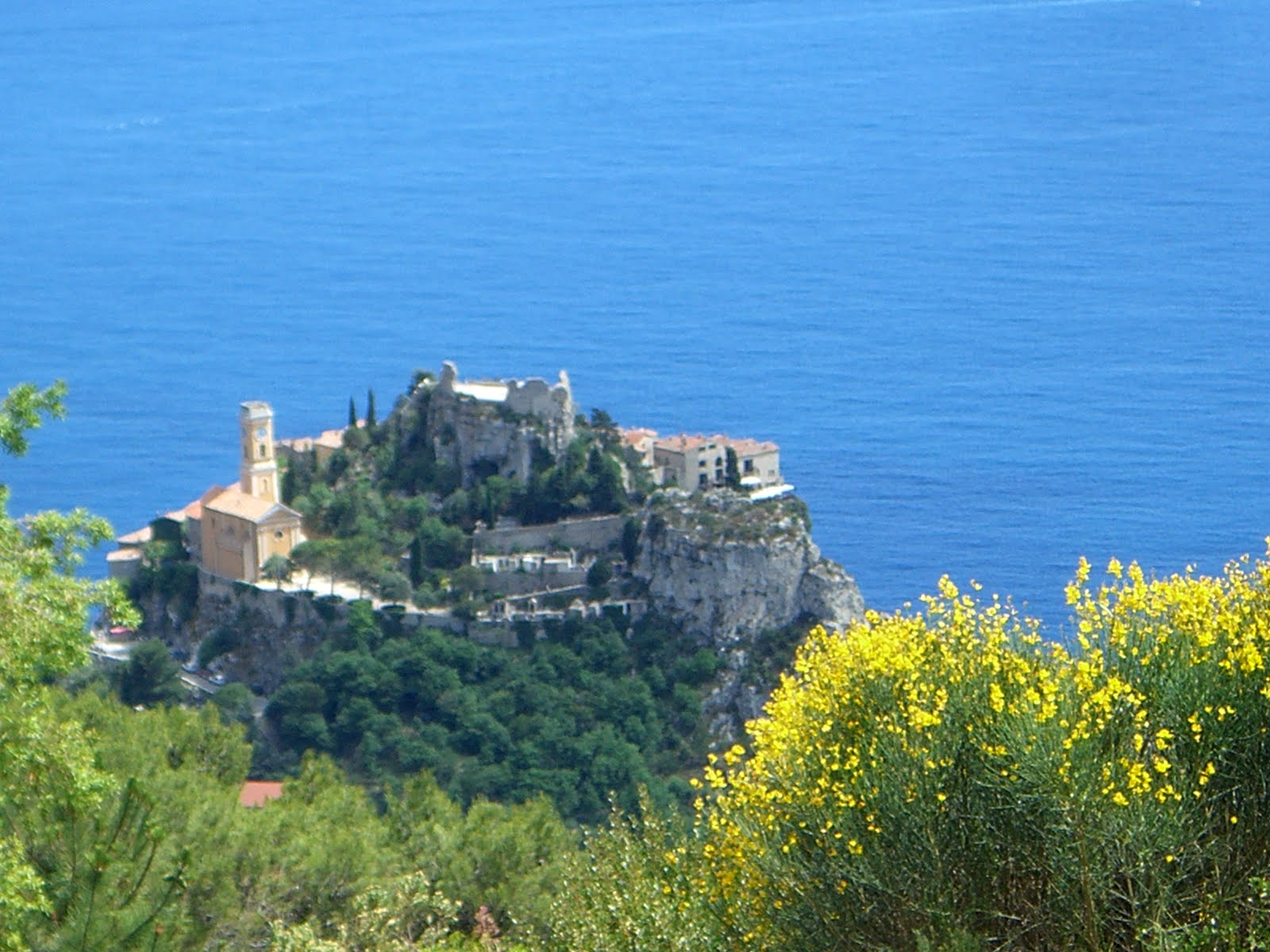
What a terrific view of the medieval Eze Village, perched on a rocky hill! 

Here's a virtual tour. If you like what you saw, let's get down to the Moyen Corniche (middle ledge or mid-level road), and explore this place.
The parking lot at the foot of the village - it easily gets full, but, it's free on Sundays.
Medieval walled villages were built, contained within the high walls, to protect the population from invaders. A hill is an ideal location for this to serve as a fortress.
All the basic needs of the villagers, as wellas the tourists, are provided for on the street level. There is a post office, a bank, a tourist information center, a super market, restaurants, ample parking space, a gas station, souvenir shops, a church, a pharmacie, with only a hospital that's missing. Tourism is the main industry here, all year-round.
Let's go! One of the best souvenir shops is to the right, in that small hotel, L'Arc en Ciel. Be sure to get a few fruit-flavored bottles of aperitif. They are among the locally-made products that are sought for by tourists. 

It's a bit of an uphill climb. Wearing comfortable shoes would make this walkabout pleasant and pain free.
The first right turn leads to an herb stand. Hmmm, the fresh aroma, almost always, makes me buy.
Next to it is the candy man's store. The nougats are a popular delicacy in the south of France. They come in different sizes. The variety of  caramelized nuts are cooked on the spot and you cannot help but grab one of those bags once you get a whiff of caramelized sugar. The other candies are sold by weight - sour balls, sweet or sour gummies, licorice, and lollipops. 
We are at the main entrance of the medieval city. The beauty and charm of this setting have been preserved through the years. Throughout the centuries, large fortifications were built to protect the village from the invaders. This is what remains after King Louis XIV ordered for the ramparts and castle to be demolished - just  one double-gate which serves as the entrance to the village.
These lucky fortress dwellers have all the wonderful views around them.
The narrow alleys and steps lead up or down. We have taken a shorter route to get to the middle level...
to visit the church, Notre Dame de l'Assomption.
There was a special celebratory mass for the people who had served during the war, being attended by the surviving veterans and their families.
A quintet provided uplifting, heavenly music during the mass.
It seems like the beautiful faux finish in this small, beautiful village church is in need of repairs as they are being eaten up by the salt crystallization on the limestone.  

On the same level of the church is a small cemetery. From there is a pathway to go up to the exotic botanical garden on the highest point of the village.

This is the view of the village, below, from the side of the church.

We'll just keep on walking to check out the little, quaint shops.
It's like an outdoor gallery, with little sections to visit and shop. 
Local artists and craftsmen showcase their creations here - all part of the village life.
Many of the ground level sections of the multi-level houses - which would have been the dairy barn section in the olden days, have been converted to store spaces - art galleries, fashion wear, jewelry, French provençal linens, arts and crafts, etc.
It was here, when it was peaceful and quiet in the village that one of its famous inhabitants, Friedrick Nietzsche - the German philosopher, wrote Thus Spoke Zarathustra: A Book for All and None - a treatise on philosophy and morality.
Restorations are ongoing - you can tell from the finishing or the color and size of the stones and the mortar.  
Here is a part of the perimeter wall - on our way to look for a place to eat.
The famous Chateau de la Cheve d'Or, a five-star, luxury hotel with a two-Michelin-star rated restaurant. 
At Les Ramparts - one of four restaurants, we had a table with a view of the Mediterranean sea and St. Jean Cap Ferrat.
In season - Asparagus with bechamel sauce and mashed potatoes topped with caviar (a recommendation by the maitre 'd)
 
Fettucini with artichokes, capers, and black olives
Half of Steak for two
Mille Feuille (which means a thousand leaves) with fresh wild strawberries

That was a sumptuous meal. Full and satisfied, it's time to burn those calories! More walking...
and, finally, we are on our way down. 
This is another place to get your souvenirs, before walking out of the village.
This ends our tour of the medieval Eze Village.

The merry month of May is festival time in the south of France. Last year, We had the chance to attend one, here. It is best to come early as parking is organized somewhere else, then a shuttle to the fair is provided. You will want to avoid the long wait, the crowds, and the hot sunny hours.
It's a weekend affair where the visitors are treated to the ways of the medieval days. 
The merchants come in their medieval-designed costumes. There are reenactments of old sports and dancing and singing a during the day.
Cooking in the ways of the olden days - very labor intensive
An artisan is working on finishing a leather knife-holder.
The local confiseurs (confectioners - candy and jam makers), pâtissiers (pastry and cake chefs), boulangers (breadmakers) come to sell their goods.
The cheese man is still setting up his booth.
A table of hand-hewn knives, horseshoes, plus other knick knacks
Medieval arms: épées (swords)...
arc et la flèche (bow and arrow)
A medieval game for the kids
Red wine - the medieval recipe of Hypocras des Pays d'Oc calls for flavoring the red wine with cinnamon, ginger, nutmeg, honey, rose water, orange and mace.
Freshly baked fruit tarts, cookie squares, and filled sweetbreads and sandwiches
Pancetta (Italian bacon), sausages, and dry-ham products
With his portable oven, this man prepared a sampling of Medieval flatbreads.
To end our visit here, we ordered the gluten-free version made with chick-pea flour.

I hope you have enjoyed this visit. But do come to this place, someday. There is so much more to see.  

Parfumerie Galimard offers their fragrance products for sale at their shop and a free guided tour of their museum:
Place General de Gaulle - 06360 Eze
Tel: 04 93 41 10 70
International Tel: +33 4 93 41 10 70
Fax: +33 4 93 41 27 61

Fragonard Perfume Factory & Boutique invites you to visit their facilities, for a free guided tour, to learn some of the secrets in perfume making.
L'Usine Laboratoire
Eze-Village 06360 France
Tel: +33 4 93 41 05 05
Fax: +33 4 93 41 02 95
Hours: 8:30 a.m. - 6:30 p.m. 
(except November to January - close from 12:00 noon to 2:00 p.m.)


For some good French cuisine, I suggest the following restaurants:
Gascogne Café (+33 4 93 41 18 50). Located across the street from the village, it's a small restaurant that is simply decorated, but the food is quite good at very reasonable prices. They offer formule menus, which even give you more value for your money. I have tried their Salad Niçoise, Steak aux Poivres, and Saumon Grillée with delicious accompaniments - all very good.
Hotel Hermitage Eze (+33 4 93 41 00 68) This small, three-star hotel has a restaurant open for lunch and dinner. It is located on 1951 Avenue des Diable Bleus 06360 Eze la Grand Corniche, about a mile away from Eze Village.

The hotels in this area are more like a bed-and-breakfasts, about one-star, with no air-conditioning. There are hotels on the outskirts - in Col d'Eze (which is on the Grand Corniche), on the Moyen Corniche, and of course on the Bas Corniche (low ledge or low road) near the coast - but still close enough. It is ideal to have a car to go from place to place, but there are public transportations - bus and train services. You need to check the schedules as they are rather infrequent. 

For more information about Eze, contact Office de Tourisme (+33 4 93 41 26 00)

Saturday, 7 May 2011

In Crowded Rome for the Beatification of Pope John Paul II


Last weekend, in Rome, the mood was jubilant and over a million people came to attend the beatification of John Paul II. I was one of them. This was also an occasion to meet up with my high-school classmate and former chemistry-lab partner, Suzanne, who is finishing her studies at the Harvard School of Divinity Studies. 

We are all saints in the making. Some will be officially recognized through the rigorous process of canonization while others will be remembered as having lived saintly lives.

The process for sainthood goes through three phases, before canonization. It commences with the people who knew the candidate well. It is one's sanctity, heroic virtues, and the extraordinary ways a person had lived his life that make him a candidate for sainthood. Pope John Paul's many achievements and the manner in which he conducted his life as a man, a priest, as Pope and as a  Polish citizen is inspiring. There is a whole country that was a witness  to his works, for he was instrumental in bringing about major change in Poland  - the end of communist rule - and also in Eastern Europe, that brought with it positive worldwide implications.

Although there were issues brought up about  how he mismanaged some matters facing the Catholic Church during his term - like the pedophile cases - his life is still considered to be highly exemplary for sainthood. All saints were humans, first, with imperfections. Only after death did they become perfect in the eyes of God, for their salvation has been earned through Jesus Christ. A person whose soul goes to heaven is a saint in heaven.

On the eve of this momentous event, we decided to scope out the place. With our hotel just five minutes away from Saint Peter's Square, we were thinking that we were going to have a good spot. There was brisk action all around. The place was crowded. There was constant movement anywhere we went. This place was readied and we were just waiting for the hours to pass.
 The pop-up tents were in place in several street corners for emergencies. 
This was on via Porcari, corner via Properzio. There were many more places, including some piazzas, that were set up this way.
On one of the main streets where the pilgrims were walking through to get to the venue for the beatification, the Italian orange and apple growers had sent thousands of cases of oranges and apples for the attendees - to welcome and to give instant nourishment for the tired and hungry upon their arrival and during the day of the celebration. Much to our delight, we were offered some orange juice. Oh, that taste of sweet and sour, salty glass of fresh orange juice was so refreshing! 
After an Italian meal at Ristorante L'Eccellenza, we joined the crowd on via Borgo Angelico. All access to major streets leading to St. Peter's Square were blocked. We could only go so far.
 
There were people who were camping on the sidewalks.
 Some were trying to get their good night's rest, sleeping.
This was the farthest point we could get to and there were more than a thousand who were already out here by 11:30 p.m. They came with their mats, portable chairs, backpacks, umbrellas, food and other supplies. I realized, then, that we had not prepared for this as the others did. This called for plan B - we were going to join this crowd between five and six o'clock the following morning. 5:00 a.m. was the appointed time to allow access to the main square.

Plan C  took effect when we woke up. Suzanne had great difficulty in getting on her feet. She was experiencing so much pain in her foot that had recovered from a sprain she had suffered weeks before. With her resolve to be out there, we were on our way by 8:00 a.m. We hardly slept a wink as we could hear the people walking through our street, via Crescenzio, all night long. 
As we looked for a space to situate ourselves, I was so happy to see many young people. I was thinking that these may have been the youth he touched and connected with during the World Youth Day celebrations in different parts of the world. And some were.
We parked ourselves in Piazza Risorgimento, near the corner of via dei Mascherino, only about a couple of minutes from the square - so close but not quite. We were going to participate by way of a big screen, with the televised proceedings. Another lady we met - Lilibeth, who took charge of  providing the commemorative coins of the Pope's visit during World Youth Day held in the Philippines, joined us.

Before the scheduled 10:00 ceremony, some people began to move out of the area in search of a toilet or were feeling claustrophobic.  Some were too tired to continue being on their feet, while some were hungry and thirsty. I became part of a human chain, with my back turned - to protect our territory, along with some Italians and Poles. It was an experience to see Italian to Italian verbally battling it out, arguing that there was simply nowhere to go and to just stay put.

An Italian lady was showing signs of fainting and we ministered to her. Soon, the emergency personnel showed up.
 At around 10:15, a big applause broke when Pope Benedict came on and the beatification of Pope John Paul II was underway.
It got too hot as the sun came brightly shining that morning, contrary to the forecast for rain. This was seen as a miracle through the intercession of Blessed-to-be Pope John Paul II. Most of us came with umbrellas, and these handily served to protect us from the sun, instead.
At every reference made of the honored Pope, the flags were being waved and people were clapping. After more than two hours of watching the proceedings, we decided to have an early start before the crowd dispersed. By this time, Suzanne, who had been standing for close to five hours was bothered by her foot, even more, as it had swollen so much from just standing. We opted to inch our way out to go for lunch.

We were famished as we had not had breakfast. By skipping breakfast, we contented ourselves with some nuts and cookies to survive the morning. We were now on our way to the restaurant we ate at the night before, as it was close by. We walked in and greeted our servers who sat us down as the first clients for lunch. We were informed that it was a fixed meal and no ala carte orders would be taken. Upon perusing the menu, it was going to be too much food for us, so we said we were going to go somewhere else. Our attentive server who said that there was no place to go to as it was crowded, convinced us to stay. He made us an offer: two orders for all three of us. We happily stayed.
Ristorante L'Eccellenza
The Menu
Starter courses: Marinated Anchovies & Marinated Salmon with salad greens
A mixed platter of cooked vegetables with strips of mozarella and black olives
Primi piatti: Pasta Vongole (spaghetti with clam sauce) & Risotto Gamberi
Secondi piatti: Gamberi, Calamari, Pesca alla Griglia (grilled seafoods)
Dolci: Tira misu
Vino: A bottle of white wine

 Pasta Vongole
Gamberi, Calamari, Pesca alla Griglia
Much to our surprise, the next people who were coming to the door were being turned away. As it turned out, the whole place was practically reserved and they began to come, in groups with priests and other church officials.

Our lunch turned out to be superb. We were just in awe that we found ourselves in this place. After two  hours of nourishing our bodies, we decide to go to St. Peter's Square, for the Pope's casket was taken out from the tomb, for veneration. Suzanne decided to go back to the hotel to rest her foot.
 Lilibeth and I lined up, starting at the very perimeter of the square. The grounds at the square were littered with paper and plastic.
There was a system to this madness. There were barricades set up to contain the flow of people. The moment people began to push, we learned an Italian expression and used it to remind each other to be patient in line without pushing "piano, piano..." 
The sun got so hot, scorching at the hour we were there. We had to peel off our layers of clothing as it was cold early in the morning, to be comfortable.

While in line, groups of people were praying, some were saying the rosary. There was also singing and once started, the others would join in. For me it was a time to reflect on all that had happened so far. The messages of Pope John Paul II were rebroadcast, as we were in line. He was a man of peace and an instrument of God in major world events. We also felt he had a hand in how we got our location in the piazza, the good weather, and how we got to the restaurant, all in perfect timing.
On the right side of the square, posters were hanging in between the columns of the colonnade. Each poster was about an event that was attended by the Pope from the first year he assumed the papacy up to his last year.

The structure above is the papal apartments. The second window to the right is the one the Pope makes his appearances from, to give his noontime welcome messages and blessings to the people who gather in the square every Sunday. 
One of the most poignant scenes for me is when he prayed at the wailing wall in Jerusalem, when he visited Israel in March 2000. It was a time when he asked for forgiveness in behalf of the Christians for the sins committed against the Jews, expressed his support for a Palestinian homeland, and blessed Israel.
Inspite of his deteriorating condition, he attended the Jubilee celebration of the apparitions of the Immaculate Conception in Lourdes, in August of 2004, three years shy of the 150th anniversary. The receiver of the heavenly messages was St. Bernadette Soubirous, whose incorrupt body can be viewed in a glass coffin, for veneration, in Nevers, France.

He had a message for the pilgrims in Lourdes: " I would have liked to stay with you longer. But I find consolation in the words of Jesus. He tells us  'The Advocate - the Holy Spirit - whom the Father will send in my name will teach you everything and will remind you of all I have said to you.' The Father sends his spirit of truth and love, into the world.  And the Spirit guides us in the ways of peace. Therefore, do not let your hearts be troubled or afraid. Dear brothers and sisters, the Holy Spirit is with you."  
Spalancate le Porte a Cristo - was the message on the left side of the colonnade. It is an invitation for us to "Open wide the doors to Christ."
It had been three hours since we had lined up, to get to this point. We had to make another stop before proceeding.
 Inside the church, we were taking turns to get to the side of the barricade to have a good view of...
 Blessed John Paul II's casket. With the Swiss guards in their colorful uniforms standing on guard, we moved continuously behind the Baldacchino, in prayer.
 Although the casket was removed from the tomb for veneration, it was not opened. 
 It has not been determined whether his body is in a state of decomposition or incorrupt.
 We got out of the church at 7:45 p.m., renewed and lifted up.
 The amount of littered plastic was astounding. Bottles of water were being given out for free.
 The cleaning crew was still working round the clock.
 After we finished our dinner at 11:15 p.m., we passed by and found the same number of people in line, as at the time we were there.
The church was to remain open up to 5:00 a.m. of the following day to accomodate the faithful.   Then, the next and final veneration was at the 10:30 a.m. mass, after which, the casket was going to be entombed again.

I caught up with Suzanne, when I got back to the hotel. She had prayerfully meditated about the day's events. She felt that she was being kept by a spirit from writing her paper about the spirituality of going on a pilgrimage. This reminded me of St. Padre Pio who used to have daily bouts with the devil. She came to the decision to write about the agony and ecstasy of  a pilgrimage.

The following morning, at breakfast, we met a Polish American priest - Monsigñor Skindeleski. We had an interesting conversation with him. He brought up more stories about the peace negotiator that John Paul II was. According to him, many miracles have been reported as happening through the intercession of Pope John Paul II, after he died. I imagine, his canonization will come soon.

Before we left, Fr. Skindeleski offered to pray for Suzanne. He placed a third-class relic ( a picture of the Pope with Father that was signed by John Paul II) over her foot and prayed. Soon after, Suzanne was able to walk with some ease.

Many of you must have been watching the live telecast from Rome in the comforts of your home, with clear details of what was going on, witnessing another day in history. I stood for a total of of 10 hours on this day. I came to Rome because it was one more step I could take in following the footsteps of Pope John Paul II - a Pope who I had come to know as my pastoral leader for the most part of my adult life.  It has been another experience of a lifetime and being there was special.

Thursday, 5 May 2011

Calendimaggio Festival in Assisi, Italy

Noticing how crowded this place was, we began to inquire about what was going on in Assisi. Then, all too soon, we saw all the posters plastered all over the place.


In the beautiful, spiritual town of Assisi the locals and the foreign guests are treated to the celebrations of folkloric traditions which have transformed from their medieval roots to present-day festivals. In the month of May, Maia and Flora - Roman goddesses, were revered with the coming of each spring. This joyous celebration during the middle ages was turned into Kalende de Maggio,  with young girls dancing and singing, going around the streets into the square.
The Calendimaggio was originally celebrated by the Celts at the onset of summer when they took their sheep to graze for six months. The celebration included having banquets and bonfires, with street dancing on the top of the hill. This primitive practice was believed to bring prosperity and protection to the town's people. 


With the transformation over time, this pagan festival was reenacted in Assisi every year, on the eve of May Day. 
The whole town is decorated with banners to commemorate this tradition.


This festival celebration has taken a spiritual turn as it is now dedicated to St. Francis. It is  celebrated on the first Thursday, Friday, and Saturday in the month of May. Beginning with a medieval procession and a torch-lit parade, the citizens of Italy and her guests are treated to something of old, with the special preparation to feast on a traditional cuisine of Porchetta - the roast suckling pig.

My friend and I couldn't resist on trying out this feast - their Porchetta.
We found the Taverna de Calendimaggio that has been set up just for this festival period, situated unter the city hall of Assisi. 

They had the best presentation of the roast pig. After all the walking, we were famished and ordered two versions.
Thin slices of Porchetta are usually served in a piece of bread, but I requested mine to be just plain meat. After the meat is sliced, it is lightly sprinkled with salt. With a glass of red wine, this was four euros. It was tasty and it reminded us of the roast pork in the Philippines, Lechon. This was our starter course as we really wanted to order the special of the day, Bacala (cod fish) and Tripa (tripe). We had to wait for another thirty minutes for that. 

While we were eating, we were treated to a show on their television screen of "Calendimaggio 2010."
In a cast of hundreds, the local citizens turned-actors come out in a range of period costumes.
There are competitions with love songs, games,...
and other events. The competitions lead to winning the prestigious Palio between the two districts.
This city map details the areas that were once occupied by two classes of people: Nobilissima Parte de Sopra - the noblemen who lived in the hills (blue area), and the Magnifica Parte de Sotto - the town's people who lived in the lower grounds (red area.)

This competition reflects the rivalry between the Fiumi and the Nepis family for supremacy over the land for two centuries, in the 1300s. 
The audience is invited to participate, too

At the end of the festival presentation, a jury - consisting of historians, musicologists, and artists awards the festival prize to the district that best presented their interpretation of the return of spring in music, dance, songs, and costumes, races and games. 

Soon, it was 7:30 p.m. 
After reading the menu, we made our choices based on what we could somehow understand. We found out that there was a system to order.
Outside, by the entrance, we got into the line and were given an order form. We indicated our table number and the quantities of what our specific orders were. We chickened out of ordering the tripe and settled for the same fish course.
Back in the dining hall, we waited.
 
These are what arrived: 
Lasagna con Carciofi (artichokes)
Bacala (cod fish in a chunky vegetable sauce) and plain torta - a thick flat bread; 
Antipasto con Giullare ( bruschette and slices of salami and dried ham). 
The small plates with the coat-of-arms design was given for us to use and to take home as a souvenir. 
 
From the dessert case, I pointed to have these two. The first was like a fruit tart with apples, raisins and cinnamon. The second one was like a raisin bread.

This meal was wonderful. It was comfort food at its best. 

That visit to Assisi for one day and one night turned out to be more than a pilgrimage. We learned something more about their history and culture. This festival, they say, is something to watch and enjoy. Maybe, next spring.

LinkWithin

Related Posts with Thumbnails