Friday, 19 December 2014

The Eiffel Tower - Holiday Season 2014

No one ever seems to tire of looking at the Eiffel Tower, especially, at night. Come winter, spring, summer, or fall, it is always visited by tourists.
 
During the holiday season, it even becomes more attractive, as some decorative structures are added to keep in theme with holiday Paris.

 A globe is situated at the center, on the ground level of the 
Eiffel Tower...
...housing a white Christmas scene made from flocked, fresh pine trees, and lit up with an animated light projection.
During daytime hours, the globe reflects the rafters (the tower's legs), looking like a canopy that has been designed to house the greenery.

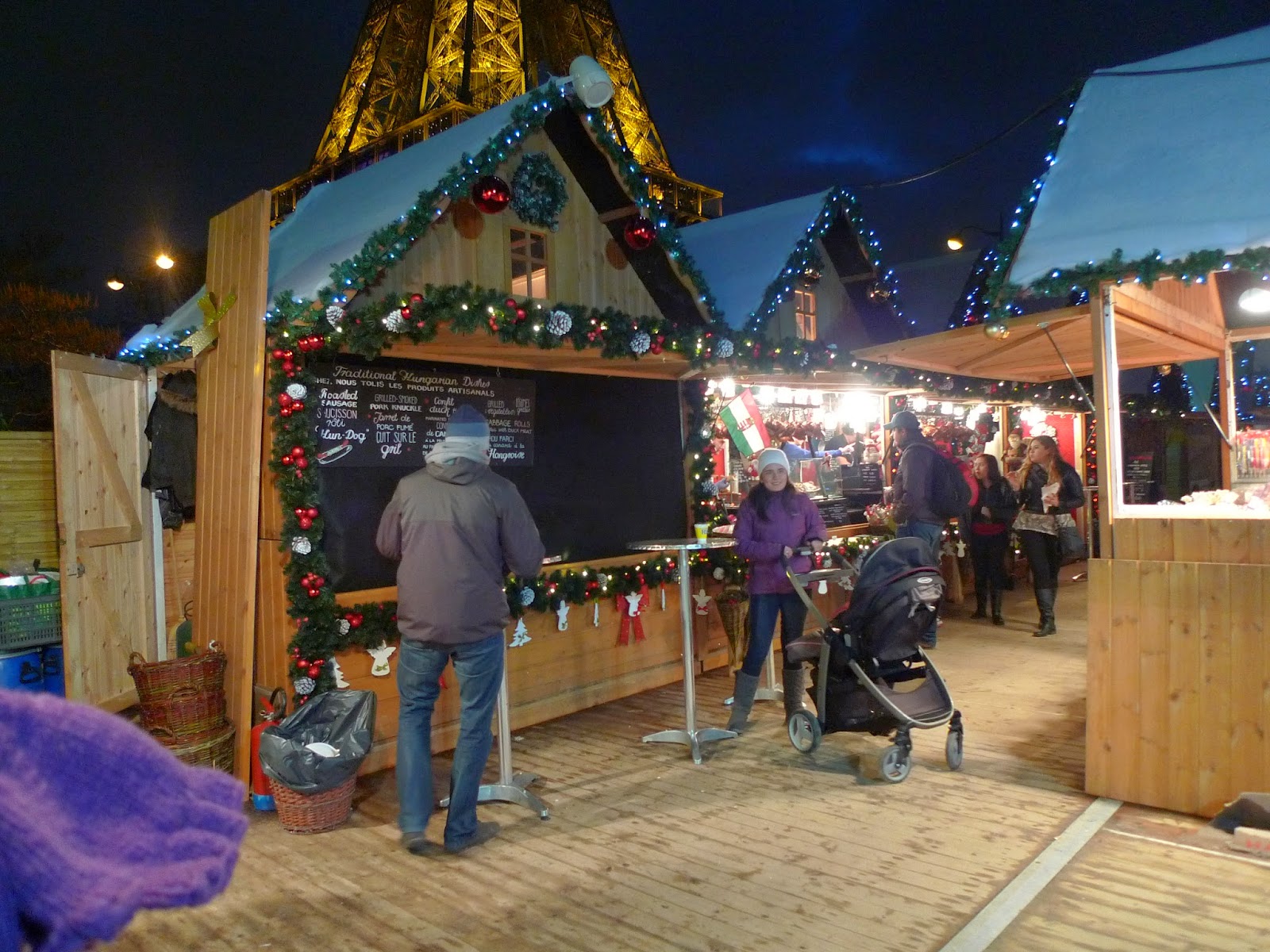
Across the street, the merry-go-round is joined by another attraction. The Eiffel Tower Christmas Market, which opened yesterday.

 The entrance - welcome to the Eiffel Tower Christmas market.
 Though it is much smaller in scale than the Christmas market at the Champs Élysées, it carries the same food and holiday-gift-idea offerings.

What a treat and convenient stop this is for the tourists who visit the Eiffel Tower - there is somewhere they can go to after, to sit, rest, drink and eat, and even have a place to entertain the young kids in - they are the captive audience for this market.

 This snow globe, right at the entrance, is a perfect for a photo op. Once inside, snow-like particles are blown to create snow, falling and swirling around, as your picture is being taken.

For those still shopping for holiday presents, there are artisanal and manufactured products - leather goods, winter clothing accessories and apparel, trinkets and jewelry, wine dispensers and decanters, decorations and other useful items. But, here is one storefront that attracts a lot of attention.
 Anything you buy from this store can be personalized.
From one of the adept machine-embroiderers who said he had a gift for me, I got my name embroidered.

As for the food, there are as many sweet as there are as many savory food stalls.
 Warm wine, sausages, pomme frites (French fries)
Paella
 Crepes, waffles, and beignets (doughnuts)

 There is quite a large selection of warm food to order here.

A sweet treat after a meal

One needs to be mindful, though, of all the processed carbs in the sweets and fast-food items, as well as the food additives that are in some of these delicious-looking foods, that are easily consumed in a place like this.

 For those who want to eat well, there are options for a more restaurant-type set-up...
 There are several floating restaurants to get to through the stairs leading to the Seine, and this is just one of them.

 
When the Christmas season is over, all will be back to normal. And the Eiffel Tower will always be a place to visit and a sight to behold.

Thursday, 11 December 2014

Part II: Les Illuminations de Noël a Paris 2014 (Christmas Illuminations in Paris)

There are more places to go for a walk to see and enjoy the holiday ambiance in the City of Lights, Paris.

Rue Faubourg de St. Honoré used to be the shopping mecca for name brand boutiques until Avenue Montaigne became the chi-chi place to shop for luxury goods. Saint Honoré, as it is popularly called is now a street lined with fashion boutiques - with up-and-coming designers, as well as, the long-established iconic French couturiers, specialty stores, art galleries, salon de thé, and cafés, bistros, and restaurants. 

There are other shops on the side streets that are worth visiting as well, like the Pierre Hermés patisserie on rue Rambeau, and other specialty shops on rue Royale.

This fashionable street is narrow, not like the wide Avenue les Champs Elysées nor Avenue Montaigne. It is still a favorite among tourists for shopping, or simply to window-shop.

On this same street is le Palais de l'Élysées (palace) - the official residence of the president of France; and the residences of the ambassadors to France of the United States, Canada, United Kingdom.

During the holiday season, this street is second to the Champs Élysées in its lighting designs. Almost store after store, the facades and the street are decorated and brightly lit with mini bulbs - with some that twinkle, or running lights that create movement, in curtain, swag and random designs.

Here is what has been put up this season on the Saint Honoré and the side streets.
 On rue Saint Honoré, heading to Place de Madeleine
 Place Vendome, on rue de la Paix - an elegant courtyard 
of high-end jewelry stores, 
and where the Ritz Hotel is located. 

 At the intersection of rue Saint Honoré and rue Royale
 Heading to a side street to go to La Village Royale
Entrance to Le Village Royale,  on Cité Berryer
 Courtyard of La Village Royale, exit/entrance on rue Royale -
with additional fashion and home stores, and restaurants.

This is the view from the steps of Eglise de Madeleine - on rue Royale,  through Place de la Concorde, with the Assemblé Nationale on the opposite side.

More hotels, restaurants and some luxury-good stores have joined in decorating for the holidays.

On Avenue George V
 George V Four Seasons Hotel
 Prince de Galles Hotel
 Bvlgari (Luxury Jewelry store)
 ArijeHaute Joaillerie - Haute Horlogerie 
(high-end jewelry and watches)

Restaurants at the intersection of 
rue Clement Marot and rue Marbeuf
 Zen Garden

Back on the Avenue Champs des Élysées
 Publicis Building - a light show on the facade, 
with ever-changing colors and patterns.

 Fouquet Hotel and Restaurant
 Changing light colors from white, gradually, to red

 Ladurée - fabricant de douce (sweets shop)

 Tiffany 

 This is the most bling-bling of them all!

Champs Élysées rond point (round about), 
where the Christmas market begins

The beauty of these holiday lights all point to the forthcoming celebration of Christmas, as we await the Light of the World -
     When Jesus spoke again to the people, he said, I am the light of the world. Whoever follows me will never walk in darkness, but will have the light of life.” NIV John 8:12


Enjoy the walk around Paris. It is so magical at this time of the year!

Saturday, 29 November 2014

Poinsettia - The Christmas Flower

The Poinsettia - the Christmas flower, has a very interesting history. Joel Roberts Poinsett (1779-1851) - the first American ambassador to Mexico, can be credited for bringing this flower-plant specie to the United States. 

In 1828, Ambassador Roberts, who was visiting the Taxco region, discovered and fell in love with a ruby-red flowered plant. A doctor and a soldier by trade and an amateur botanist, he took clippings of the plant and sent them back  home to Charleston, South Carolina. Upon his return, he shared his plant clippings with a friend - Mr. Buist of Philadelphia, who, in turn, sent it to Mr. James Mc Nab, who, subsequently, brought it to the Botanical Garden of Edinburgh.
A German botanist, Wilenow, had named Poinsett's plant discovery as Euphorbia Pulcherrima, in 1833. Hickling Prescott - a gardener and botanist who was given the task to rename the flower plant.  By 1837, the plant was renamed to Poinsettia Pulcherrima, in honor of Poinsett - for his achievements in government and horticulture. Hence, we have come to know this plant as Poinsettia, which we now find just about everywhere, during the holiday season.

In Mexico, the Poinsettia was called Cuetlaxochit by the Aztecs. The name signified "Flower that withers, mortal flower that perishes like all that is pure." It was cultivated as a gift from the gods and Montezuma (1480-1520), who was the last Aztec king to reign. The red-blood color of the flower, "served as a reminder of the sacrifice the gods made to create the universe, and the debt which would be repaid with human sacrifice." The plant's sap was used by the Aztecs as a cure for fever and its leaves were used to make a dye.

When the Franciscan missionaries settled in Taxco del Alarcon in the 17th century, in Southern Mexico, the flaming-red wild flower was used in the Christian ceremony during the nativity procession - La Fiesta de Santa Pesebre. Many stories point to this time as to how the Cuetlaxochit (Poinsettia) became to be called la flor de Nochebuena or Holy Night (Christmas Eve) flower. 

Legend has it that there was a poor, young Mexican girl - Pepita - who was heartbroken that she had no money to buy a present for the Baby Jesus. As she was in tears, an angel appeared to her and instructed her to gather a bunch of the weeds growing around the area. And when her tears fell upon the weeds, they miraculously turned into beautiful, red blooms.

Another legend refers to a time when the Franciscan friars  were celebrating Christmas with a nativity scene they had lovingly decorated. During the mass, when the star of Bethlehem passed overhead, the leaves had turned from green to bright red. Since then, the Cuetlaxochit (Poinsettia) became the symbol of Christ's blood and became associated with the Christmas season.

In Mexico, the Poinsettia - la flor de Nochebuena, is displayed on Dia de la Virgen on December 12.  On December 12, the feast of Our Lady of Guadalupe - the Patron of the Americas, is celebrated in the United States. Poinsettia Day falls on December 12, in remembrance of the date in 1851 when Joel Roberts Poinsett died.

The Cultivation of Poinsettia

At Ecke Ranch, in Encenitas, California, the Poinsettia varieties are cultivated all year round to keep up with the growing demands for this favorite Christmas flower plant during the holiday season.

In 1911, Paul Ecke started marketing the Poinsettia as the Christmas flower, as its blooming cycle coincided with the winter season, around the celebration of the holiday season. At first the Poinsettias were grown in the fields and shipped to commercial greenhouses to grow for their local markets.

By 1963, there was a change in the production as it shifted from field planting to greenhouses. They have since developed their breeding technics and have come up with some of the leading Poinsettia varieties in the world. Three generations share this breeding traditions to continue to bring us these seasonal Christmas flowers.

Some of the Poinsettia Varieties at Ecke Ranch
Ecke's Flaming Sphere

Prestige Red - the best selling variety


Freedom Early Marble

Freedom Jingle Bells

 Peppermint Twist variety (with curly leaves)
Monet Twilight (flat leaves to the right)


The parts of a Poinsettia plant


The actual flowers in a Poinsettia plant are the the small, yellowish things known as cyathia; the colored leaves that develop pigmentation after flower initiation are the bracts.

When days become shorter and nights are longer starting in mid-September in the Southern Hemisphere, the bracts begin to form their colored pigmentations. The growth phases are referred to as vegetative growth - the plant growth prior to flower initiation; the flowering stage is the reproductive stage which will take a couple of weeks. This can all be achieved with precision when time and growing conditions are taken into consideration. Here is more information about how you can successfully grow your own Poinsettia.


This holiday season, you can fill your homes and other places with the Christmas flower plant, Poinsettia, in different colors, if you please!

To buy directly from Ecke Ranch, here is their contact information:

Ecke Ranch
527 Encenitas, Suite 104
Encenitas, CA 92024

Tel. (760) 753-1134

Email: ccrysler@eckeranch.com

LinkWithin

Related Posts with Thumbnails