Monday, 20 March 2017

The Cagsawa Ruins and Daraga Church in Albay, Bicol, Philippines

The Cagsawa Church was originally built by the Franciscan friars, under the leadership of Saint Pedro Bautista in 1587, during the Spanish occupation of the Philippines. San Pedro Bautista was the first bishop of Nueva Caceres (Naga). 

A note about San Pedro Bautista...he arrived in the Philippines from Spain in 1584, as part of the fourth wave of missionaries to the country.  His first assignment was in Intramuros, where he also ministered to the Japanese living outside of Intramuros, and with the help of Fray Gonzalo Garcia, they organized the Filipinos into "town settlements." 

In 1586, he was transferred to become the parish priest in Lumban, Laguna. There he taught church music and the making of musical instruments. 

In 1590, he established the Franciscan novitiate in San Francisco del Monte.

He discovered the medical attributes of the hot springs in Los Baños. He defended the basic human rights of the indigenous people in Zambales, inculcating in the minds of the people the value of human life.

in1593, he became the Philippine ambassador to Japan, where he, successfully, averted the emperor's plans to invade the Philippines. He settled in Miyako along with his companions, then moved to Nagasaki where they established hospitals and churches. The emperor began to persecute Christians in 1596, and San Pedro Bautista was among the twenty-six Christians -  four Spaniards, one Mexican,  who were all Franciscan missionaries; three Japanese Jesuits;  seventeen Japanese laymen; and three young men who were members of the Third Order of St. Francis - who were crucified and speared to death on February 5, 1597 in Nagasaki. The Martyrs of Japan were canonized by Pope Pius IX on June 8, 1862. They are listed in the calendar of saints as Sts. Paul Miki and his Companions, and commemorated on either February 5th, 6th, or 13th by different Christian denominations.

This image has become so famous as it is used in posters to promote tourism in the Bicol region.

The architecture of this Franciscan designed church had one belfry, with a convent attached to the church, along with some patron and venerated saints like San Francisco, San Antonio, San Pascual Baylon, San Buenaventura, Nuestra Señora de los Angeles and more, in the interior of the church.

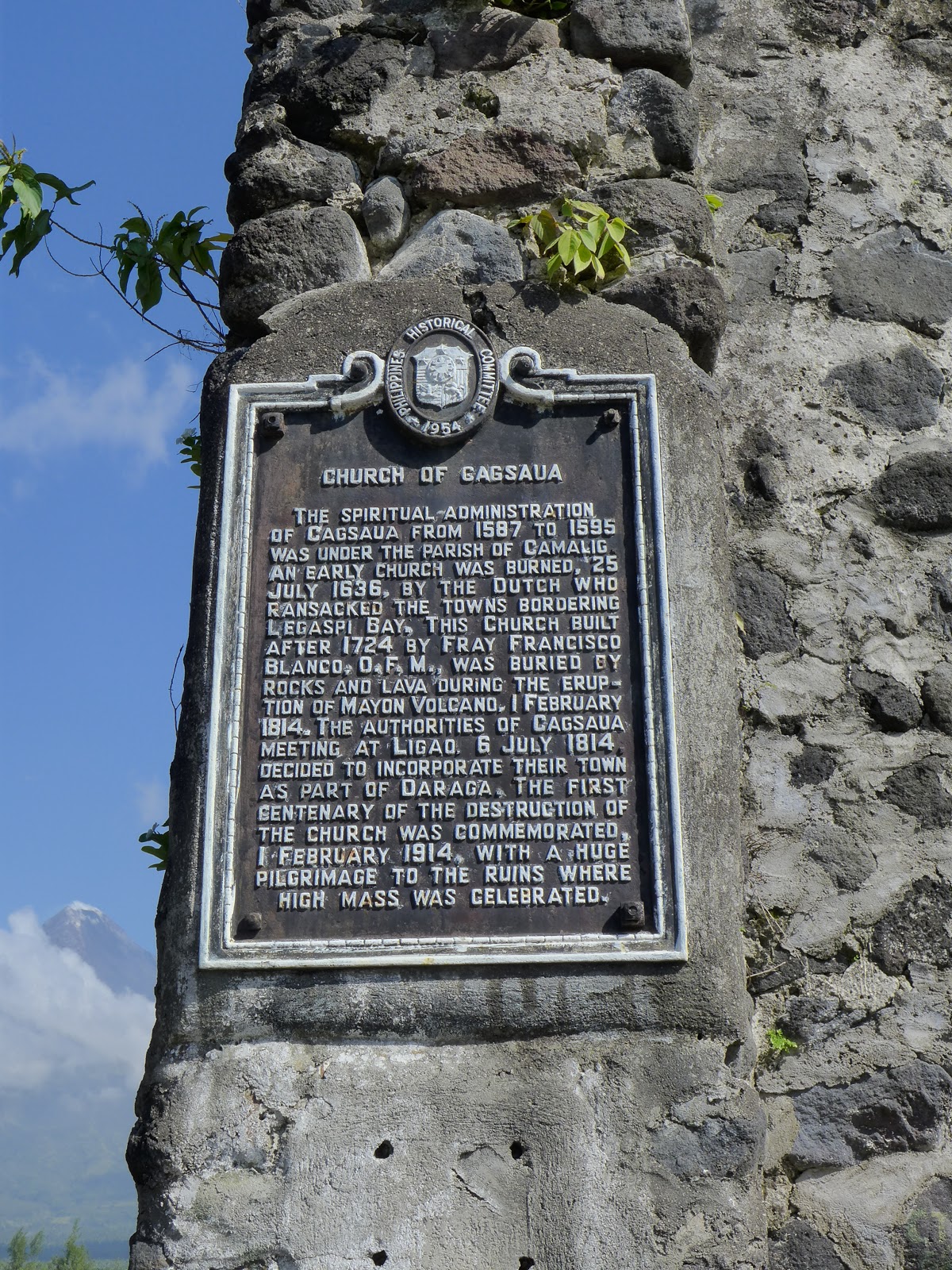
The church was rebuilt in 1724 by Fr. Francisco Blanco, after the original church was burned down by the Dutch in 1636, when they attempted to invade the Philippines during her Eighty Years War with Spain that began in the 1500s.

On February 1, 1814, Mayon Volcano became active, which turned out to be a deadly eruption. The church was destroyed and about 2000 inhabitants from the surrounding areas were killed when they went to the Church to seek shelter and protection from the volcanic eruption, as the dense mass of very hot ash and lava, along with explosive gasses from the volcano flowed down  at a very fast speed. 

Though, the church facade survived, several volcanic eruptions almost leveled it to the ground in the 1950s. What remains today is the bell tower and some parts of the convent, with an imposing background of Mayon Volcano.

What was once the Cagsawa church, is now known as the Cagsawa Ruins Park, in Barangay Busay, in the municipality of Daraga, Albay, in the Bicol Region. 

The park is the site of the Cagsawa branch of the National Museum of the Philippines, where geological and archeological exhibits and pictures document the history of the volcanic eruptions.
Mayon Volcano at midmorning, with a ring of cloud formation that appears after 7:00 in the morning.


This is a view of Mayon Volcano early in the morning, with a noticeable smokestack, which we discovered during an early-morning walk near our hotel. 

In July of 1814, the local officials decided to incorporate their town with Daraga. Thus, the local townspeople had another place of worship to go to - the Daraga Church.
 Daraga Church - Our Lady of the Gate Church

Under the patronage of Nuestra Señora de la Portería 
(Our Lady of the Gate)


The church is distinguished by its striking facade, with elaborate Baroque elements. The architecture features "solomonic columns, flowing cornices, and bas-relief images of saints and religious seals carefully carved through the entire face of the church." 

It was built atop a hill by the Franciscan Friars in 1773, with the use of volcanic rocks. A coating of lime has been painted on the volcanic bricks to protect them from the elements.

 A message from Our blessed Mother...

Nuestra Señora de la Portería 
(Our Lady of the Gate)
 A prayer to Our Lady of the Gate


The other venerated saints

 A painting of Nuestra Señora de los Angeles in the Cagsawa Church

 A depiction of the exodus of the local people during the destructive eruption of Mayon Volcano in 1814

 The austere church interior

The Cagsawa Ruins (also referred to as Kagsawa, Cagsaua) has become one of the iconic places to visit in Albay. From there, it is but natural to continue on to the Daraga Church, to continue the story of the plight of the people as a result of the fiery temperament of Mayon Volcano.

Monday, 30 January 2017

La Giralda Tower, Seville, Spain

After our visit to Plaza de España, we went back to where we had started our walking tour of Seville, at the plaza in front of the cathedral and the tower. 
The La Giralda tower is not to be missed, while visiting Seville, Spain. At the top, it is a lovely, panoramic view of historic Sevilla.  La Giralda is one of the iconic landmarks  that rises to a height of 103 meters.
La Giralda was the minaret of the Alijama mosque that was built in 1195, used to call the faithful to prayer. It was significant in the Islamic faith and was given much importance by the Moorish rulers.  The completion of this tower took twelve years. It is is an example of Almohad architecture, which took hold in Seville after the reconquest of the city by King Alfonso X in 1248. The Moorish rulers wanted to destroy it rather than have it be used as part in the practice of another faith, but they were threatened to death by the king should any attempt be made to take even just one stone. Thus, it was eventually turned into the bell tower  of the Cathedral of Seville.                                                                                                                                                                                                                                                                                                                                                                                                                                                                                                                                                                                                                                                                                                                                                                                                                                                                                                                                                                                                                                                                                                                                                                                                                             

It takes its name from the Spanish word girar - to turn. Giralda means "she who turns." At the top of the tower was a weather vane of El Geraldillo - representing faith in the four corners of the world.
A view of some of the Gothic features of the cathedral as we entered through this key-hole designed portal
We dared to climb the tower and it turned out to be worth it.  It was a climb that involved going up 35 inclines with ramps. This was used by the muezzins - the guards who went up to the top, two at a time, riding their horses or donkeys to call the faithful people to prayer. 

ON OUR WAY TO THE TOP
Looking out the windows

The tower was built with red bricks, with beautiful trellis designs forming the windows with a series of arched niches. Each side of the tower showcased a different trellis design. In the original design as a minaret, the tower was crowned with four copper balls and topped with a crescent moon. In the mid-14th century, an earthquake destroyed part of the tower and it was restored with a bell tower and a cross. 

The tower was consecrated as a Christian church in 1248 and used as a cathedral until it was restructured to be the tower next to the construction of the cathedral of Seville. In the back are the leaves of a 14th century door that is believed to have been part of the Sagrario Chapel, with Gothic writing and verses from the Qur'an.
In the 16th century, the upper portion of the bell tower was renovated to four-storeys, with a weather vane on the top. 
A replica of the weather vane displayed on the grounds of the cathedral

The finished structure was a blend of Moorish and Renaissance architecture. 
 The belfry at the tower

THE VIEW FROM THE TOP - HISTORIC SEVILLE

The Courtyard - view from the top
The courtyard between the cathedral and the tower planted to orange trees - an original feature of the minaret
The drain system in the courtyard dating back to the 12th century

View of the Archbishop's Palace to the left

One of the doors in the minaret, now part of a collection of artifacts on display

Our exit point

While looking from the ground level at the cathedral and the tower next to each other, there is a noticeable difference in the materials used in their construction. According to our tour guide, the use of the bricks in La Giralda was a reflection of the belief in Islam that worldly things will not last forever, while the use of stones in the cathedral signified a solid foundation in our faith in God.

Next on our agenda to visit was the Cathedral of Seville.

Sunday, 15 January 2017

Plaza de España, Sevilla, Spain


For the adventurous travelers, going around Spain on your own is very doable and economical. And when I travel with my family, the first thing we do is to take a walking tour of the city, which is free most of the time, and then, after, we decide to reserve and buy tickets to further explore. 

In our walking tour in Sevilla, Spain - courtesy of Pancho Tours, one of the places we went to was Plaza de España.
Plaza de España is located inside the Maria Luisa Park, right next to Avenida Isabella la Catolica, along the Quadalquivir River. This was the last stop in our walking tour. 

We accessed this place through walking along the avenue, entering near the Teatro Lope de Vega, after hearing the historical details about the cathedral, the La Giralda Tower, and the Fabrica de Tabaco.

This plaza is also reachable by public transportation from the Prado de San Sebastián, which is serviced by metro, by bus, or by tram.

Upon entering the building, we were delighted to see the beautiful designs of the azulejos (painted ceramic tiles), as my daughter and I had taken several classes in ceramics and this was one of our interests to check out in Spain.

Plaza de España was built for the Ibero-American Exhibition of 1929. In this international exposition, with Sevilla as the host city, this was the Spanish pavilion - one among several located around Parque Maria Luisa (Park Maria Luisa). 

This world fair - Exposición Iberoamericana de 1929 - was held from May 9,1929 to June 1930,  to foster better relations between Spain and the other participating countries - the United States, Portugal, Cuba, and some countries in South and Central America which were former colonies. At the same time, Spain aimed to showcase her culture, and social and economic progress. 

Don Anibal González was the Spanish architect for the prominent building surrounding the Plaza de España, along the whole length of which were the various Spanish regions and provinces of Andalusia. 

Next to the cathedral, this is deemed as the second most beautiful structure in Sevilla. The large scale and intricacies of this building design were simply grand!  

The city of Sevilla planned and prepared for this major event for 19 years. Though, it was smaller in scale than the one hosted by Barcelona in the same year, nevertheless, it was grandiose in scope. As part of the preparation, the city embarked on a modernization program which included putting up new hotels and widening the old, medieval streets to make room for more vehicular traffic, in anticipation of the large number of visitors. Most of the foreign pavilions were designed as permanent structures and, now, some are used as consular offices, a museum, a dance studio, ...... 

In this building, the Salón del Descubrimento de America was  and is housed. This was the largest exhibit of all which included the personal belongings of Christopher Columbus - letters, documents, maps and other things related to the discovery of the Americas; the last testament of Hernan Cortés - he was in the first wave of Spanish colonizers in the colonization of the Americas, and was responsible for the fall of the Aztec Empire and the take over of a big section of the main city in Mexico in the early 16th century) ; dioramas depicting special moments in Spanish history. A replica of the "Santa Maria" and her crew - the ship of Columbus, was displayed on the Quadalquivir River.

According to our tour guide, the big investment made for this  by the Spanish government of this exposition did not pay off. The expected number of visitors did not materialize, mainly because the international exposition in Barcelona - which was much bigger - was taking  place at almost the same time and for a longer period of time. Barcelona was visited by a big number of international visitors that Sevilla was hoping for.

The Spanish pavilion is a brick building in a semi-circular fashion, with coaxial elements of bricks and  water showing off Spanish craftsmanship, with a fountain that draws the eye to the center. 

The size of the plaza measures about 50,000 square meters. There is a portico on the ground level which is bordered with balustrades and balconies.
From the building facade into the plaza, there is a wide pedestrian path of bricks, a canal, then the plaza where the fountain is the focal point. To crossover, there are 4 bridges - representing the four ancient kingdoms of Spain: Castille, Aragon, Navarre, and Leon - to connect to the center of the plaza. 

In the spring and summer, row-boat rides can be taken along the canal. We came on one rainy day, last fall, and this boat ride was no longer available for the tourists.
The bridges exemplify Spanish ceramic craftsmanship in the use of ceramic tiles, ceramic balustrades and railings, to accentuate the brick works. 

 
The semi-circular building is finished on each side by the north and south towers.
**********
Pabellones de las Regiones Españolas (Pavilions of the Spanish regions) - these are the ceramic provincial alcoves which featured the different Spanish provinces and regions, along the canal wall.
The design of each provincial alcove included a tableau and the side borders/benches extending out, with the use of azulejos to represent the arts and culture and other unique features of each province, along with a map.
Here is one of the alcoves - for  Cadiz

Cádiz, as explained by our tour guide, had played a very significant role in the progress of southwestern Spain. The city of Cádiz is the capital of the province of Cádiz, which is part of the autonomous community of Andalusia. An autonomous community was defined in the Spanish constitution of 1978 as a region being guaranteed to have limited autonomy to self govern  their nationalities and region.

It is the oldest city in Spain that has been continuously inhabited, and has been the base of the Spanish Navy since the 18th century when the Spanish Bourbons came into power. Also in this city is a prominent educational institution - the University of Cádiz - which was founded in 1979 and is known for its medicine and marine curricula.

In our bucket list now to visit, this is a typical Andalusian city, a place with old-world charm - with beautiful vistas, well-preserved historical landmarks, and remnants of the wall in the Old City. In the newer parts of the city, there are numerous parks with exotic plants, with  humongous trees that were supposedly introduced by Christopher Columbus to Spain, from seeds he brought home from the New World.

**********
The Architectural Style of Plaza de España 

The architectural style of Plaza de España reflects the  Renaissance and Islamic influences. The Mudejar style was emphasized during our walking tour of historic Sevilla. It refers to the Islamic influences on Spanish art and architecture which we saw all over Sevilla, during our walking tour. This resulted in the architecture that was created by the Muslim under Christian rule. The sophisticated designs are elegant and intricate in the use of horseshoe-shaped arches, minimally landscaped and peaceful-looking courtyards with a drain system, intricate carvings with repetitive geometric designs and motifs from nature, and the use of tiles. 

Nature is integrated in the overall design, in palaces, houses, mosque, and as we have seen at Plaza de España. Particular attention is given to having beautiful, lush gardens in the courtyards to provide shade and to create a restful place. There are geometric patterns on the walls, the doors, and on the floors. Fountains and reflective pools both indoors and outdoors serve as focal points in the open spaces.
The Mudéjar style evolved from the gradual mixing of Islamic architectural features with the Christian artistic styles from the north. When Sevilla was reconquered by Ferdinand III in 1248, the prevailing Gothic style began to mix with the Almohad style. 
The Almohad style brought the schematic, geometric designs in ornamentation. This can be seen in some of the tile designs and in the doors.

There is more to see in Sevilla. In our three-day stay, we also got to visit the cathedral, climb up La Giralda Tower to get a panoramic view of the city, and walked by several iconic buildings and landmarks. With an extra day or two, it would have given us time to go to Alhambra or visit Cadiz. Maybe, next time!

LinkWithin

Related Posts with Thumbnails