Tuesday, 21 December 2010

Rome: Part 5 - Basilica di Santa Maria Maggiore

The Papal Basilica of Saint Mary Major, known in Italy as the Basilica Papale di Santa Maria Maggiore, is one of four papal basilicas. This church holds a special place in my heart, because of a relic that has something to do with the celebration of Christmas.
Santa Maria Maggiore was built under Pope Sixtus III's reign, dedicated to the Virgin Mary, to encourage personal devotion to the Blessed Mother, in the 12th century, after the Council of Ephesus decided upon the relationship of the Virgin Mary to the Incarnate Christ. In the Council of Ephesus, the central debate was about the "nature and status of the Virgin and incarnate Christ.” And "the conclusion came that the Virgin was in fact 'Mother of God”.
The first thing I noticed was the different mosaic patterns on the floor, which appeared to me as a symbolism of the Word as it is spread to the four corners of the world.
Among the mosaics found in Santa Maria Maggiore is this one, which is one of the oldest depictions of the Virgin Mary in "Christian Late Antiquity... The influences of these mosaics are rooted in late antique impressionism that could be seen in frescoes, manuscript paintings and many pavement mosaics across villas in Africa, Syria and Sicily during the fifth century."
The ceiling detail of the basilica
In the background is the altar. In the foreground is the nativity crypt, designed by the architect Domenico Fontana, to house what was presumed to be the relic of the Nativity crib.
Frontal view of the reliquary
On the glass portion beneath the golden cover of the reliquary is a partial view of the manger.
Here is a view of the famous icon of the Virgin Mary in the Borghese or Pauline Chapel of the Basilica. "It is known as Salus Populi Romani, or Health of the Roman People." The icon is  regarded as having miraculously helped to keep the plague from the city.  It is at least a thousand years old and traditionally believed to have been painted from life by St. Luke the Evangelist. According to published materials at the Basilica, radiocarbon dating establishes it to be approximately 2,000 years old, thus, "reinforcing its sacred tradition."
The basilica has undergone major reconstructions and renovations. By looking at this stain glass window, the design style and colors tell me that this came at a much later date. Consistent with the theme, the image is that of the Mother and Child.

It is not that I need relics to prove the birth of our Lord, but seeing one brings me closer to his personhood, as I imagine seeing Him on the manger.

May I wish you a very merry, blessed Christmas and a new year full of divine blessings.

Rome: Part 3 - Sunday, on the Piazza with the Pope

For Roman Catholics, the Vatican is a major pilgrimage destination. It is where the Holy See is, where the pope - the successor of Peter, resides as the bishop of the diocese of Rome.

This square in front of the basilica was redesigned by Gian Lorenzo Bernini from 1656 to 1667. It was precisely designed so that many people could see the pope give his blessings, either from the forefront part of the façade of the church or from one of the windows in the Vatican Palace.


Part of the Vatican Palace rises behind the colonnade. Bernini, who had been working on the interior of St. Peter's for decades, was also asked to reorganize the open space. Included in his plans was designing the colonnades, in Doric style.

Here, the pope's coat-of-arms design is perched up at the beginning of the colonnade structure.
Bernini made the fountains as the foci of the ellipse-shaped piazza, with the colonnades looking like arms about to embrace them.
My family and I joined the rest of the people gather around, after hearing the 11:00 a.m. mass, at St. Peter's square, in anticipation of the pope's appearance at about noon time. It was a Sunday, and Sunday is the day of the week when Pope Benedict communicates with the pilgrims in Rome, on the square.

At the center of the piazza stands an Egyptian obelisk of red granite, used as a centerpiece for the piazza by Bernini.
I call this point zero, from which one stands to see all the columns in the colonnade become a waved wall with no spaces in between.
The crowd applauded as the flag was let down, indicating that the pope would be making an appearance, soon.
When the pope showed up, the people welcomed him with a warm applause, some waving their white handkerchiefs, and group banners were propped up to be seen. It was the pope's turn to welcome us. He named the countries from which groups of pilgrims came from, delivered his brief message in different languages, blessed the religious articles and then he gave his blessings.
Soon after, the people - feeling blest to have been present for the pope's blessings, began to disperse, some through Villa Della Concilazione, and most likely heading to lunch at a place, nearby, or to do more sightseeing.

We were getting hungry and we decided to go to Hotel Columbus, which was just about a 10 minute walk. Let me tell you - this place was beautiful!

Sunday, 19 December 2010

Rome: Part 2 - The Christmas Season at St. Peter's Basilica at the Vatican

When in Rome, visiting the Vatican is always a must for me, as this is the seat of my faith. Two years in a row, I have had the good fortune of coming to visit this place at this time of the year.


On the way to Vatican City

At St. Peter's Basilica, I am drawn back to the biblical history of when Peter was named as the first pope of our church, when Jesus commanded him to “Feed my lambs.... Tend my sheep.... Feed my sheep”.


On Villa Della Concilazione, entrance to the piazza with the basilica in the background, created by Benito Mussolini.

Walking towards the basilica

A perspective look at the nave of the basilica

The first thing you will notice is a crowd gathered at a side altar to the right of the church, as they view Michelangelo's "La Pieta."

Font for the holy water

Notice that on the sculpture of St. Peter the toe-details of one foot have been smoothened out as pilgrims have continued to prayerfully touch it through all these centuries.

Many biblically-themed "paintings" adorn several side altars. The original paintings were removed during the last world war and, today, they are very intricate mosaics that pilgrims get to look at. Hard to believe? Look closer and you will see very small, colored tiles used to replicate the original designs.

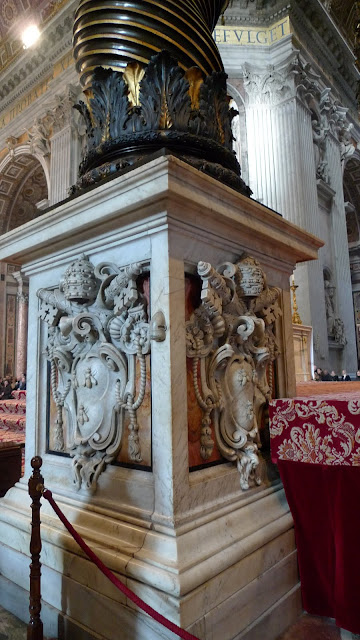
The Baldacchino is a masterpiece by Bernini. Directly below it, on the underground level, is the tomb of St. Peter.

The pope's coat of arms adorns the base of each column of the Baldacchino.

The main altar behind the Baldacchino, where only the pope can say mass

Ceiling detail above the main altar

The cupola


An archway from the middle part of the nave, leading to the side of the cruciform layout, where several small chapels are located.

The manger scene from last year's display, under the changing colored spotlights...

as seen in regular lighting.

This time, we decided to visit the Vatican Museum. Upon entering from the inside of the church, the Eucharistia, the list of popes really impressed upon me the solid link of the Roman Catholic Church to Jesus Christ, from His first appointment of St. Peter to the present pope.


I was eagerly looking for the manger scene display, this year, but this was all they had, so far.


Out on the piazza, a giant Christmas tree stands close to the makings of a manger scene. On Sundays, this place fills up with pilgrims from all over the world, who come to see and listen to the papal address.

We'll be back on a Sunday, then.

Rome: Part 1 - The Christmas Season at Piazza Navona and the Spanish Steps

I had an invitation to go to Rome to meet up with family. What a treat it was. After checking into our hotel, our first stop on our walk was the Christmas market at Piazza Navona.  

As I looked for what was new, I was so enthralled to see the stalls carrying the Bethlehem scenes and characters, as it reminded me of my childhood, and when my kids where young, when they participated in the manger scene characters as the three kings. 

The principal characters for the Christmas scene
New this year: automated scenes of local tradesmen at work
Village people at work, to add to the Italian country-side setting around the manger scene.
This structure will be used as the setting for a live reenactment of when Christ was born, on the eve of and on Christmas day.
As soon as we left the piazza, we headed towards the Spanish Steps. There's a bit of history about these famous steps. 
On via dei Condotti, the place was deserted as it was late at night. When we got to the piazza of the Spanish Steps, we noticed that the Christmas tree lights were turned off. 
The Fendi building was the most brightly lit place.
The Mercedes Benz Christmas tree

The Spanish Steps was a design solution by a young architect, Francesco de Santis, to connect the French Church of Trinita dei Monti that was built in 1425 at the top, to the area below. With his elegant design of twelve ramps leading down the staircase of 138 steps, he was able to get both the French and the Papacy, who had their own issues against one another, to approve this design solution. The execution of the architectural design was funded by a French diplomat, Étienne Gueffier.

In 1723, this became the grand, marble staircase leading to the piazza below. Since then,  other elements have been added. The Sallustian obelisk that was brought to Rome by Octavian Augustus was installed at the top of the staircase in 1789. At the staircase landing, in the piazza, the Barcaccia - a fountain designed by Pietro Bernini in the shape of a boat was added, below the road level, in 1629, as commissioned by Urban VIII Barberini.

When in Rome, a walking tour of this area is a must. From the top and going down down to the piazza leads to the high-fashion houses on via Condotti and  galleries along via Margutta,  for your shopping experience. The cafés and restaurants are tucked in the little streets from via del Babuino, with a few serving what seemed to be delicious, home-cooked meals. 

The name of this place -  Escalinata Española (in Spanish) or Scalinata della Trinità dei Monti (in Italian) was in honor of the connection, by location, of the Bourbon Spanish Embassy (ambassador to the Holy See) to the French church. The Bourbon kings of France were the patrons for the  church.This was a neutral name that was acceptable to the French and to the Vatican. 

In an area towards the via del Balbuino, it came to be known as Piazza di Francia. To this present day, the red house on the right side of the staircase - once the residence of the English poet, John Keats, is still there. 

There is much history in this place that is omitted in most of the city tours of Rome. On your own, do an investigative tour and you will have a lovely time. This will be a treasure of discoveries. The Spanish Steps is visited by both the locals and foreigners. It is also a place of gathering for people and  a venue for occasional performances.


Same time last year, this was how it looked.
What a different feeling one gets when the place is filled up with people. You can feel the energy and the life of the place.
It was getting too cold and it was time to call it a day. We took Via del Babuino to get to our hotel. The next day, we went to Florence. I'll tell you about it in my next post.

LinkWithin

Related Posts with Thumbnails