Sunday, 11 December 2011

San Juan Capistrano, Part 2: Basilica of San Juan Capistrano and the Serra Chapel


The San Juan Capistrano Mission is considered a place of historical, cultural and religious significance. The preservation of this place honors the different traditions of the American Indians, Spain, the Spanish missionaries, the Mexicans, and the other local inhabitants who have contributed to its heritage in the last  270 plus years. 
From this scale model, the location of the present-day basilica - Mission Basilica of San Juan Capistrano, is northwest of the original location of the historical Mission of San Juan Capistrano.
Mission Basilica of San Juan Capistrano

This is a Roman Catholic church in the city of San Juan Capistrano, California, under the Diocese of Orange. Its construction begun in 1984 and was completed in 1986. The design is patterned after the Mission's Great Stone Church of adobe construction, which was built in 1797 and seriously damaged by the 1812 great earthquake that hit Southern California. The present day church is twenty percent bigger than the original mission church, as designed by architect John Bartlett and built by Joseph Byron, Jr. of Alex, Sutherland Construction. 
The church's interior was designed by Dr. Norman Neuerberg, a historian, who painted the patterns on the walls. 

Dr. Neuerberg based his designs on studies he conducted on the Great Stone Church. He also visited the hometown of Fr. Junipero Serra (the founder of the mission) in Mallorca, Spain 


During the jubilee year of 2000, Pope John Paul II conferred the tile of minor basilica on this church. This status is granted o a church that has gained religious, historic, and cultural significance. This also indicate a special relationship with the holy See, as it is designated as a place where the Pope and the Petrine ministry are solemnly honored and supported. As a basilica, it becomes a major pilgrimage center. 


The papal crest, that of the reigning pope - at this time it is that of Benedict XVI, can be found outside the basilica, above the major entrances. To the pilgrims, this means that they are about to enter "a special place that is both honored and dedicated to the Holy Father." The other features in the basilica include the tintinabellum - the basilica bell located up in the bell tower situated to the right side of the sanctuary; the ombellino - the basilica umbrella once used to protect a traveling pope from the natural elements, found inside the sanctuary near the ambo (pulpit).
The Grand Retablo

Measuring 42-foot high and 30-foot wide, this sixteen-ton backdrop to the altar is made of cedar and covered in gold leaf. It is in the style of the 17th and 18th century Spanish and Mexican colonial retablos. At the center, towards the top, is the Holy Trinity - the crucifix, the ancient patriarch above the cross representing God the Father, and the dove to signify the Holy Spirit. 

Beneath is the image of Our Lady of Guadalupe. At the different corners are Saint Francis - the founder of the mission's order; Blessed Kateri Tekakwitha - who was an Indian maiden; St. Joseph, and Blessed Junipero Serra. The retablo was designed and created at the Talleres de Arte Granda in Madrid, Spain, by 84 artists.

The tabernacle
A prominent side altar in honor of Our Lady of Guadalupe and her chosen instrument, Juan Diego

Juan Diego was a native Mexican of little means and education. He was a weaver, a farmer, and a laborer. Born in 1474 in the town of Tlayacac in Cuauhtilan, about twenty kilometers from Tenochtitlan (Mexico City), he was a very spiritual man who made regular trips, on foot, to receive catechetical instructions and hear mass. His town was established by the Nahua tribesmen in 1168, and conquered by Axayacatl, the Aztec lord, in 1467. This was at a time when the war had ended a few years before and the religious fervor of the people was growing. 

On one of his treks to go to church, to pray for his sick uncle, he heard a sweet sound and climbed up the hill to see where it was coming from. There, he saw an unusual vision. There was a beautiful woman who appeared like an Aztec princess in what seemed like a bejeweled surrounding, who called out to him on Tepeyac Hill. She identified herself as the Virgin Mary and asked him where he was going. As he briefly explained what his task was for this day, she lovingly responded to him that his prayers were being heard. Then she  asked him to do something for her, to deliver a message to the bishop of Mexico. To this he bowed in submission and left his cares to the Virgin Mary, and he went about to see the bishop.

The bishop was skeptical to hear this message from the Virgin Mary, for a church to be built on the site where she appeared. It was to be a temple where she would show her love to all, her compassion, give help and protection, to listen to their prayers and laments, and to bring relief and answers to their prayers about their miseries and sorrows, for she was their merciful mother. The bishop asked for more information and proof as to the identity of Juan's celestial visitor.

With other things on his mind, Juan got sidetracked when he found out his uncle was dying. He missed his next rendezvous with the Lady. But, she met him on the path he had taken to let him know that his uncle was going to be cured and to go back to doing his mission for her.

After his third visit to the bishop, narrating the same course of events that led him to there, in the first place, the bishop had Juan followed, to track him down to see what he was up to. But they lost sight of him. Juan was saddened by the bishop's deaf ears to his message.  It had gotten harder to see the bishop in his subsequent visits, since the first time. 
During the fourth apparition, the Lady asked Juan to go up the hill to gather what ever he would find there. It was the month of December when freezing temperatures made it impossible for anything to grow, not even weeds. To his surprise, Juan found colorful flowers with the sweetest scent. He gathered them and carried them on his tilma (a blanket, cape) that he was wearing to keep him warm. When he showed them to the Lady, she asked him to bring the roses to the bishop as proof of who she was.

Juan went back to the bishop's palace to bring the proof that had been requested. But the servants and the other workers would not let him in. They wanted to see what he had in his tilma, but he would not let them. Thy grappled with him to take whatever he had, but when they opened his tilma, there was nothing but painted images. Finally after his long, persistent wait, and convinced that he had something important to show the bishop, they let him in.

Juan explained to the bishop that this was the proof being sent to him that he my believe the message of the Lady. As soon as he unfurled Juan's tilma, Castillian roses dropped down to the floor - a variety that did not grow in Mexico, and to the amazement of the bishop and the others in the room, the image of the Lady was imprinted on the tilma. With sorrowful hearts, they prayed for forgiveness for their unbelief and their actions.

The bishop took the tilma and placed it in the chapel and, thereafter, asked Juan Diego to show them the site the following day. Then, Juan wanted to go home. Accompanied by the bishop's people, they all met the uncle who had miraculously recovered and was happily up and about. The uncle, Juan Bernardino, told them the story of how the Lady had visited him to cure him and explained to him why his nephew could not come home, as she explained the reason for sending him to the bishop. 

The construction of the basilica began in 1531 with the design of architect Pedro de Arrieta, and completed in 1709. Juan Diego's tilma was transferred here from the chapel of the bishop's palace in 1709 and stayed there up to 1974. A bomb was planted in the church in 1921 by an anti-clerical activist. The explosion damaged the building's interior, but the tilma survived, with some minor damage. In time, the basilica started to sink as the city was built over a lake. A new basilica was constructed close to the original location. The old basilica, after repairs and renovations has been reopened to the public, and this is where the perpetual adoration is held. 

The modern-looking basilica - a circular building, was built in 1974 to 1976 by Mexican architect Pedro Ramirez Vasquez, who used a structural design with a major pylon to keep it from sinking. Next to Vatican City, this receives the next highest number of pilgrims who come to visit, annually. Our Lady of Guadalupe has been declared as the patroness of the Americas. 


Many wonder why Juan Diego was chosen as the deliverer of a very important, heavenly message, as invisible as he was to much of the society. As it is in most Marian apparitions, Mary our Mother, has appeared to simple-minded children. Matt 11:25, in Jesus' reply to those around him: "I give praise to you, Father, Lord of heaven and earth, for although you have hidden these things from the wise and the learned you have revealed them to the childlike."

Juan Diego never got to see the completed church. He died on May 30, 1548 at the age of 74. He considered himself  a nobody - "a small rope, a tiny ladder, the tail end, a leaf." In the eyes of our Lady, he who was of simple faith - walking 15 miles each time he went to hear mass, was the best instrument for her message to the world. He was canonized on July 31, 2002 by Blessed Pope John Paull II, and with this prayer he asked for his intercession: "Blessed Juan, you faced the skepticism and rejection from a bishop and the crowds to bring Mary's message to Mexico. Pray for us when we are faced with obstacles to our faith, that we may show that same courage and commitment. Amen." 

The feast of Our Lady of Guadalupe is celebrated on December 12. Through her intercession, may there be peace and healing in our world. 

Continuing on our tour, a visit to the Serra Chapel in the east wing, was next.
The Serra Chapel in it's original state, dating back to 1782

On weekdays, there is daily mass at 8:00 a.m. On Sundays, a Latin mass is said for the Sunday worshippers, in the same tradition before the Vatican Council II changes were put into effect. 


The preservation of the remnants from the great earthquake in 1812 of the Great Stone Church and the other adobe-constructed buildings have been completed. Fund raising efforts are being done to continue with the preservation of this historic landmark -  with the Serra Chapel waiting to be the next priority. 
 
The faithful kneel down in front of the communion rail to receive Holy Communion. The retablo is original.
Santa Teresa de Avila

The design details in the chapel date back to Fr. Serra's time, giving us a glimpse of the art style from back then. A faux marble finish and the border patterns are inspired by their daily lives as farmers, with the use of plant motifs, the earth colors and and the color green. 
The ambo (pulpit) that is still in use by the mass celebrant, during the delivery of the homily
 
The original baptismal font
 
A peek at the central courtyard - this was were much of the activities went on during the mission's early production years.

Presently, a few rooms in the courtyard buildings are now used as showcases  for the display of artifacts used by the American Indians who were christianized and their lifestyle; some rooms are being used as offices.
On Mrach 19, on the feast of St. Joseph, people from all walks of life, from all over the world gather at the Mission San Juan Capistrano, year after year, to witness the miraculous return of the swallows. Preceded by the scout swallows a few days before, the main flock usually arrives at dawn and starts rebuilding mud nest on the ruins of the old stone church.


After their summer stint at the mission, the swallows all take off  on October 23, first, circling around the mission to bid it goodbye. As the circle has no beginning and no end, the swallows would be back again in the spring, making a full circle of their coming and going.


Less than a decade ago, on March 19, 2003, the U.S. National Conference of Catholic Bishops conferred the status of national shrine to the Mission San Juan Capistrano. It continues to be a center for pilgrims to experience a deeper spiritual renewal and conversion, since the mission was established.


This historic landmark is considered to be the birthplace of Orange County. The mission is open for daily tours. With the addition of a parochial school and buildings for the use of it's parishioners, and the availability of the central courtyard for use for wedding receptions; corporate events; concert venue; shows featuring garden, arts and crafts, there is much going on here.

Mission San Juan Capistrano
26801 Ortega Hwy
San Juan Capistrano, CA 92675
Tel. No. (949) 234-1300
Visitor Information: http://www.missionsjc.com/visit/visit.php

Wednesday, 7 December 2011

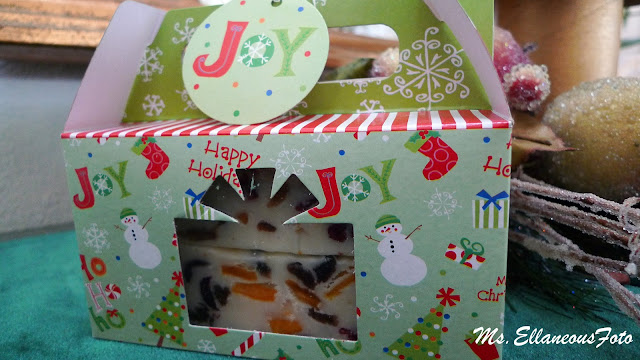
Fruit Fudge for the Holidays

I have been cooking, baking and packaging my Christmas giveaways to family, friends and neighbors. Then, my friend shared her fudge recipe via Facebook, a couple of days ago, and I have been playing around with it, adding different things:  
3 cups chocolate chips
1 can of condensed milk
1 cup nuts 
1 tsp. vanilla


The recipe is easy to make and it's fun to be creative with it.

From the basic recipe, I came up with a FRUIT FUDGE, as inspired by my Bejeweled Fruitcake. This has become one more addition to my holiday gift boxes of goodies to give away. 

Preparation time: 30 minutes
Do-ahead preparation: line a meatloaf pan with parchment paper, on all sides. Crease the corners.


INGREDIENTS:
3 cups of premier, white chocolate morsels (1 1/2 bags or 18 oz.)
1 can condensed milk
1 cup candied mango, diced to the same size as the other candied fruits
1/2 cup dried cranberries
1/2 cup raisins
1 tsp. orange rind, finely chopped (or zest)
1 tbsp. brandy
1 tsp. butter


PROCEDURE:
1. Place all your fruits in a bowl and add the brandy and toss lightly. Set aside.

2. Throw the white, chocolate morsels and the condensed milk into a flat, thick-bottomed saucepan and cook at a low temperature, stirring constantly. My setting was at "2" out of "10" on a glass-top burner. 


2. When the white chocolate is melted and blended with the condensed milk (about 15 minutes of cooking time) turn off the flame and add the fruits with the brandy and mixed well to incorporate the fruits. Add the butter, and continue mixing.


3. Pour the mixture into your lined pan. Shake it a bit to even the spread and let it cool on a wire rack for several hours. If you are in a rash, refrigerate it. 

4. Place it in the freezer for 10 minutes before cutting it up. Use a sharp knife to cut the fudge into the desired sizes - for sampling or for packaging.


From a sampler size, my food critic (my daughter) said that it tasted like a fruit nougat. The orange rind gave it a burst of fresh flavor.


This one is good to go!

Have fun with your fudge making. Make your own versions and do share what new creations you come up with. 

Tuesday, 6 December 2011

Holiday Gift Ideas

The Christmas countdown has begun. With the decorations in place, I've been doing research on gift ideas for my friends and family. The tradition of giving presents during the holidays can, sometimes,  seem like a burden when trying to find budget, fappropriate options. Lately, I've been exploring new recipes for the perfect home-made gifts along with interesting books. It is is important to not only feed the stomach, but, the soul. I can't wait to share with you more tips and DIY tricks in upcoming posts. For now, here are some great deals on books that may be of interest to you:


The Year's Top 20 in Fiction


San Juan Capistrano, Part 1: Christmas at the Mission

It's a season to be spent with family and friends. On the occasion of a visiting friend, we included "Christmas at the Mission" in our schedule of things to do in San Juan Capistrano.

After patiently dealing with the long queue on the 5 Freeway exit to Ortega Highway (74 Freeway), we made it to San Juan Capistrano, though, later thn we had thought.

The town was festively decorated and full of Christmas spirit.

We missed the lighting ceremony in the park.

We got to the mission and did not have to wait in line for too long as we had pre-bought our entrance tickets the day before.
It was a perfect welcome as we heard this group of carolers sing our favorite Christmas carols.
The San Juan Capistrano Mission grounds were lit up and we were free to wander around. It was like an open house.

Located in Orange County, Southern California, San Juan Capistrano was founded by the earliest inhabitants of the land. They were Indians who were hunters and gatherers. There before the Europeans came in 1776, the tribes passed on the leadership within the family, with a council of men to support the leader of the community. They were peaceful people who only resorted to war to avenge crimes committed against them. They had a deity - Chinigchinich, whom they worshipped with their own religious ceremonies, in a small structure centrally located in each community.

Spain had already colonized Mexico in 1519. Not too far up the coast, she continued to colonize  the New World, and came upon the West Coast in the 1700s. The Spanish explorer, Hernan Cortes, set up military installations and planned to transform the Orange County Indians into Spanish citizens, even encouraging intermarriages between the military personnel and the local maidens. Soon, the Spanish missionaries arrived to teach the Indian population, to convert them to Christianity. The  missionaries divided the Indians into two groups, based on their proximity to the missions: the Juanenos and the Gabrielinos. These were small tribes thought to have belonged to the Shoshone family, who shared a common language.  

The organization of Spanish missions were dependent on existing conditions. The San Juan Capistrano valley was ideal as it was arable land, with fresh water supply, and a local population to do the work. For this work, they were promised Spanish citizenship. On November 1, 1776, it became the seventh mission in California. This was one of the most successful missions, producing from farming, herding, candle and soap making, iron smelting, tanning, and weaving operations. The other natives were involved in building abobe homes for the native and intermarried families. 

However, things changed when Mexico earned her independence from Spain. A Secularization Act came about in 1833 which diverted the mission lands to go to the political appointees, and not to the Indians as previously promised. Instead, the land grants were issued to powerful men and their families, and this started the Rancho system. 

San Juan Capistrano was declared as a pueblo and the mission was sold to John Forster for $710.00, an Englishman who had settled down there after marrying the governor's sister. The decline at the mission's productivity began. 

In 1848, the American victory over Mexico brought them the California territory, and statehood for California came in 1850. Life and culture changed. Mexico sold 55% of her territory to the United States, including Arizona, California, Texas, New Mexico, Colorado, Nevada, and Utah for $15,000,000.00. 


The statue of Junipero Serra


Fr. Junipero Serra, a Franciscan, was the Spanish priest who led the band of missionaries that ended here. Soon after the mission was built, Fr. Serra fled when he faced opposition from the American Indians. He did come back to bring them to Christianity. Language presented a problem to effective communication. But they managed to train the Indians to do wine making, tanning, blacksmithing, ranching, and manage small business operations. Fr. Serra's other problem here was how the Spanish military was using the Indian labor for its purposes, like slave labor, in their military campaign. In the eyes of his parishioners, his religious message was in contradiction with the military's program.

A controversy came up as an issue brought against Fr. Junipero Serra's cause for sainthood accused him of having taken advantage of the Indian population and mistreating them. He had taken the normal course of feeding the Indians with milk to make them strong, as they did in Spain. But some of the children died. It was only not too long ago when science came with the pronouncement that the coastal people who lived along the San Juan Capistrano valley were lactose intolerant. This was something that Fr. Serra could have not figured out nor diagnosed.

His beatification came on Sept. 25, 1988. It was a descendant of native Indians, Andrew Galvan, whose forefathers were baptized by the missionaries, who came to fight for Fr. Serra's sainthood, along with Fr. Noel Francis Moholy who had advanced the cause for his sainthood.
We wandered through the grounds which were once part of the stone church.
In what used to be the main altar section, the manger scene is displayed, a place where the visitors came to pay homage to the Infant Jesus.
On December 8, 1812, an earthquake with a magnitude of 6.9 caused major damage to several structures in the mission, while the main church was destroyed, killing 40 natives who were attending the 3:00 p.m. services. It is believed that the earthquake had ruptured from the San Andrea's fault, at Wrightwood.

There are remnants of the little that survived the earthquake and they have been left on the grounds. From the stoneworks in view, there were no metal bars to reinforce the walls. The bell tower was among those badly damaged. 
As we crossed to get to the central courtyard, Mariachis were entertaining us with their traditional Mexican songs.
A stage was installed for some performances, for the public.
Activities for the family included this costumed set, for a picture-taking opportunity.
In one of the rooms in the corral, art activities were organized for the children. Here, they are decorating a toy made of a round wooden disc, with two strings running through the middle. 
The finishing touches on the old buildings are visible here: stucco mud was applied over the stones, then smoothened up; while bricks were applied as a surface treatment to pillars.


As we toured the rooms around the corral, we saw how the Indians lived and worked during the time of the mission's existence.
An olive press
A scale-model of San Juan Capistrano Mission


Junipero Serra's favorite saint was a warrior missionary, Giovanni de Capestrano, born in 1386. He died on October 23, 1456 and was canonized in 1690. Fr. Serra had gotten permission to name one of the missions after him, thus he named this the San Juan Capistrano Mission.


After statehood, this town changed from being peaceful to chaotic. Squatters, drifters and bandits came. It became a relay station between San Diego and Los Angeles. With this traffic, cowboys who were brought in by the ranch owners would cause drunken fights on the streets. Stagecoach bandits and robbers became plentiful.

Later on, because of its location, the town saw a real state boom with the rise in construction for homes, stores and a hotel, with the discovery of gold in Northern California. It was after the 1900s that stability began to settle in, when it became a farming community, once again. With drought and a small pox epidemic and an increase in land taxes, the rancho system went into decline. Land was bought by people interested in farming. Previously, barley, oranges and walnuts were planted.  With the railroad system that had been set up there in 1887, their products became accessible. This resurrected the prices of the land. 

Through out this time, the mission remained in disarray. Efforts were made but it was only in 1910, when Fr. John O'Sullivan came, that progress was made towards the restoration of the mission. It is because of a general plan, designed by the citizens in the 1970s, that this historic site has been preserved, allowing us to have a glimpse of the unique heritage of the mission, in perpetuation. 

The mission San Juan Capistrano is a non-profit historic site sustained by tourism and donations. If you would like to help, you can make your tax deductible donations payable to the Mission Preservation Fund, P.O. Box 697, San Juan Capistrano, CA 92693.

Coming to celebrate Christmas at the  Mission was another occasion for families and friends to get together, to get into a deeper religious experience about Christmas. There are other reasons to come and visit this place, and for me, that is to hear mass at the Serra Chapel, which is the same chapel that dates back to 1776.


San Juan Capistrano Mission
Ortega Highway (74 FWY) west of Interstate 5
Open daily from 8:30 a.m. to 5 p.m. 
(closed Thanksgiving, Christmas & Good Friday p.m.) 
The Mission grounds are available for private functions and corporate events. 
Guided tours of the Mission can also be arranged. 
For information, call (949) 234-1300.

Saturday, 26 November 2011

Decorating for the Holidays


It's that time of year when we change gears and go into decorating for the holidays, from Thanksgiving to Christmas. A trip to Roger's Garden in Newport Beach, California,  made me think of how I was going to decorate the house to celebrate our favorite time of the year.
 Lots of ideas are presented here.


Decorating for the holidays goes back to centuries past. The use of light during the Christmas season has been  a tradition among Christian and non-Christian cultures.  In the mid 17th century, small candles were used to light up a Christmas tree. Glued with melted wax to the branches of the tree, they festively lit up the tree. 

When electricity was discovered n the 19th century, Edward H. Johnson - who had become the president of the Edison Electric Light Company, had Christmas light bulbs of red white and blue made especially for him, which he then hand-strung together. He headlined in the papers as having had the first electrically illuminated, revolving Christmas tree, which was pretty, elaborate, and entertaining to his children and his guests. He soon became known as the "Father of Electric Christmas Tree Lights."  

At the White House, President Grover Cleveland had the family Christmas tree illuminated with multi-colored light bulbs, in 1895. It was a luxury reserved for the wealthy as it is estimated that it cost about $2,000.00 to light up one Christmas tree, in the early 1900s, when General Electric started to market the Christmas light kits.

It took a fire in New York in 1917, due to the use of candles on the Christmas tree, for change to happen. Albert Sadacca, then a young man of fifteen years, was moved by this tragedy that he persuaded his family who owned a novelty lighting company to manufacture Christmas lights that were to be sold at a reasonably affordable price. First, sales were poor, but as electricity became a household utility, the use of electrical Christmas lights eventually became popular and part of decorating for the holidays. Albert and his brothers organized National Outfit Manufacturers Association in 1920 - a trade organization, which later became the  NOMA Electric Co. Their associate members, together, cornered the Christmas light market until the 1960s.

In 1932, the practice of lighting the National Christmas Tree on the south side of the white House to commence the holiday season celebration was initiated by President Calvin Coolidge. Then, with the stellar attraction of a lit up, giant Christmas tree at the Rockefeller Center in 1956, many more Americans got enthused to decorate for the holidays, indoors and outdoors. 

The trimming of the Christmas tree is a take off from a pagan practice. In the pagan tradition, boughs of evergreen branches were decorated with gold and silver and brought into the home to honor the winter solstice between December 20 and 23. As the days were getting shorter, the pagans feared that the world would come to an end. With the evergreens staying fresh, it gave them hope.

Our present-day tradition of decorating the tree dates back to the 16th century in Western Germany. It has different symbolisms for different people and faith traditions. In the Christian tradition, it is pointed to heaven above - a reminder to us to seek heavenly treasures more than earthly ones. 

For both religious and secular interpretations, it is the "Tree of Humanity." The decorated Christmas tree only became popular to the western world in the 19th century. From paper ornaments to glass balls and Christmas lights, they now come in a variety of themes as depicted by ornaments made from glass, plastic, resin, paper and other materials. Once only measuring about two feet and set up on the dining table, it was in America that decorating taller trees gained popularity.
 
 
The theme for the "reason for the season" - the birth of our Lord in the manger scene.

Collectors' items:
 
What makes an item collectible? For what reason does one start a collection? We all started collecting something when we were still young. When we look at what we have gathered, each piece brings back a memory.

In collecting Christmas ornaments, the artist's style is much liked by the collector. Each piece added to the collection, year after year, is carefully chosen based on one's taste. Some may collect from a singular  designer's work, while other's may collect from a number of designers. The collection maybe thematic or random, depending on what appeals to the collector. As time goes on, each piece is likely to bring back memories.  For others, collecting is an investment that they plan to cash in, in the future.
After visiting the Metropolitan Museum of Art in New York one Christmas season, almost 12  years ago, I was inspired to collect a Christmas nativity village. Through the years, I was able to add a major piece or two from the Fontanini Collection. This year, in place of the usual big, decorated Christmas tree, I have set up the nativity village in a cascading manner, in one corner of the living room. This design came to mind when I remembered the Church of the Holy Sepulchre in Israel, which was built around the different levels of the whole mountain side - where the markers of where Jesus was nailed to the cross, died, and was buried have been incorporated. 


At the top of my display is the Emperor's Pavilion under guard by a soldier, and below it is the census taker at the Census Building, then the village people going about their daily lives. Next to the right is the Holy Family with the Weaver's Tent above it.
The manger scene

The nativity of our Lord - the crèche, has always been the major theme and focal point in our Christmas decorations at our home. It is the retelling of the story according to the Gospels of Luke and Matthew.  Matthew 1:21: "She will bear a son and you are to name him 'Jesus,' because he will save his people from their sins.”

The commercialism of the celebration of Christmas is nothing new. During the middle ages, St. Francis was inspired to create a nativity scene when he saw some shepherds and their flocks on the hills in Greccio, Italy, and also his visit to the birthplace of our Lord in the Holy Land. He envisioned a live production of the manger scene - the birth of our Lord, to bring the biblical teaching about the birth of our Savior to the people, that they may have a deeper experience about the Christmas holiday being celebrated. This was to inspire the worship of Jesus.

He proceeded to Rome to get permission and Pope Honorius lll gave his consent for St. Francis' elaborate plan to recreate the nativity scene. With the help of a rich nobleman from Greccio, Giovanni, the production cost was funded. And so it came to pass in a cave in the countryside, in Greccio. People were hired to play the parts of  Mary, Joseph, the shepherds, with a life-size wax figure representing the infant Jesus. To complete the scene a manger, straw and live animals - the ox and donkey, were added, under the direction of St. Francis. In the meantime the local town's people noticed all the goings on on the countryside.

On Christmas eve, in 1223, the local inhabitants came to the hillside to worship, and they began to understand the meaning of the first Christmas in Bethlehem. Just like the shepherds, angels, and the three kings, they came to adore the Infant Jesus. According to St. Bonaventure's writings based on the eyewitnesses' accounts, St. Francis was overjoyed for the people, for the deeper religious experience they had gotten out of this.
The nativity scene, at Christmas time, is the most precious to me as it gives meaning to what the Christmas celebration is all about. We have St. Francis to thank for this tradition of displaying the nativity scene at Christmas time. It is a great reminder of God's love for us, when he sent his Son to be among us, to save us. 


This nativity set gets set up on my coffee table. When my kids were still young, I assigned each one of them to play the role of one of the magi. They took each king with them and they were supposed to travel and make it to the table on Christmas day. As I looked around a couple of days after, one king had landed on the bar, another one was behind the bedroom door, and one was by the front door. That was an interesting journey for the kings who eventually made it on time to join the shepherd and his flock, to adore the new babe wrapped in swaddling clothes.
In December, 2009, I had the blessing of visiting Rome. At St. Peter's Basilica, this manger scene displayed on the side of the church received center stage attendance among the pilgrims.


In the family room, I livened up some sections with... 
 Christmas village scenes - on a side table...reminiscent of the days we used to go up to Lake Arrowhead for the kids to enjoy some winter play in the snow...


and on my piano.


When I started decorating, I decided that I was not going to buy anything and will just have to do with what I had and could find around the house. For the snow cover, I used paper towels; for the mountain backdrop I used the paper bags from the super market - cut them out to lay flat, then crumpled them in no particular fashion and stretched them out to drape around the areas I wanted to cover. For the the piano winter scene, I sprayed the crumpled paper lightly with white paint in a well ventilated area.
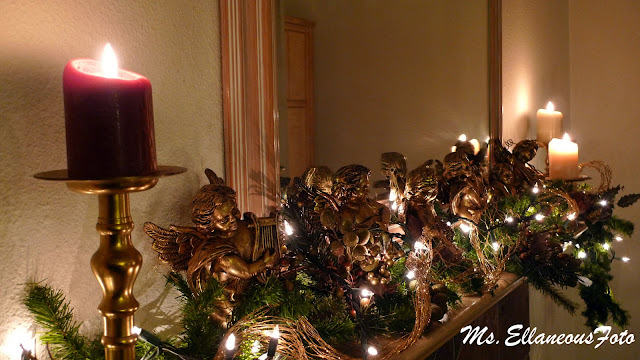
A choir of angels on my fireplace mantel

Decorating during the holidays helps put us in the spirit. For merchants, it attracts the consumers to their stores. However you prepare for the holidays, may it be a meaningful celebration for you and your family. Happy holidays and have a blessed, merry Christmas.

LinkWithin

Related Posts with Thumbnails