Wednesday, 16 March 2011

Around Paris: Lunch Time and Tea Time in Saint-Germain-des-Prés

When ever you travel or visit a place, when a local person tells you where to go to experience a delightful meal at a very reasonable price, take down notes and go. 
In our case, a friend of mine and I were led to a little restaurant, by our common French friend, in a side street from the Boulevard de Saint-Germain-des-Prés.
Tucked away on rue Saint-Benoit is Le Restaurant du Petit Saint-Benoît, established in 1901. After being around for over a hundred years, this place would be considered historical, right?
We took a little tour and inside, we found several frames hanging on the who's-who wall - about who has been here. There were artworks and autographs of French artists, intellectuals, and writers who frequented this place. 


Among them were Jean-Paul Sartre (1905-1980, Nobel Prize in Literature in 1964; best known for his writings on existentialism),  Jacques Prévert (1900-1977, French poet and screenwriter who was active in the surrealist movement), and Serge Gainsbourgh (1928-1991, dubbed as the greatest French songwriter in the sixties and seventies who wrote and sang about his decadent lifestyle). 

The weather had warmed up to 18°C, the sun was out and there was a cool breeze.  We came early enough to choose prime seating - outdoors. After we read the menu of traditional French food, our server came to give us the special for the day and that was what we each ordered.
 Pave de Cabillaud aux croûte de sésame
Sesame-crusted cod, the fried fish skin, with potato/broccoli puree floating on a blend of olive oil and the saucy part of the purée. This was simply outstanding, all for only13 Euros.

4, rue Saint-Benoit 75006 Paris France
Tel, no. 01 42 60 27 92

For our tea or coffee after our meal, our friend recommended that we walk down the street towards the boulevard to a special place to be among interesting people.
This is the place - Café de Flore - in art-deco style, which appeared on the scene in 1887. It is one of the most famous sidewalk cafés which was popular among the 19th century French personalities, and now frequented by the modern-day French intellectuals and artists.
We ordered the decadent chocolat de Flore, instead, and while we were sipping our hot choco drinks our friend identified the person who was previously seated at our table in the covered-outdoor section as a French writer; and someone who she thought was Amanda Lear, who was seated inside, within direct view of where we were seated.

Amanda Lear was the model who posed for Salvador Dali in some of his paintings and was his confidante for seven years. She was a fashion model in the sixties, a disco queen in the mid seventies, a television personality in the mid eighties, and has been dabbling in television and the movies, music, writing and pursuing a painting career since the nineties.
Where Jean-Paul Sartre lived, diagonally across from l'Eglise de Saint-Germain des Pres, just a short walk to Café de Flore

Back to Jean-Paul Sartre - he used to meet up with Simone de Beauvoir at Café de Flore. These two had a relationship as "intellectual equals" and they made their life commitment to each other with an open-relationship, fashionable - "with the freedom to love others with openness and honesty". One of her writings entitled Le Deuxième Sexe (The Second Sex) was about how "one is not born a woman; one becomes one." This work established her as a "political and philosophical thinker" and summed up the defining points of the women's liberation movement - for equality and independence. She dedicated herself to the feminist movement. 


It was an afternoon of reminiscing about some of the noted french personalities of an era gone by. There are many more tales about this section of town...if only the walls could talk! 

Café de Flore
172 Blvd. Saint-Germain-de-Prés, corner rue Saint-Benoît
75006 Paris, France
Tel. 01 45 48 55 26

Sunday, 13 March 2011

Around Paris: Discovering the Neighborhood of "Little India"

Every now and then, my daughter and I get a craving. This time, it was for some Indian food which could be found in the Indian and Sri Lankan neighborhood in Paris... 
easily accessed by Metro - line 2, exit La Chapelle. The other streets that spell out the boundaries of this section of Paris are rue Louis Blanc and rue Perdonnet.
It was a regular day and there was no traffic. We were window shopping at first as Sri Lankan and Indian businesses/stores were beckoning us to come in and take a look.
The Indian saris were simply beautiful silks, intricately detailed with silver or gold threads and beads. The jewelry was just as equally attractive. And yes, we did go in to see more!
When we got to the restaurant row, we looked around at the menus of different restaurants and settled to have our late lunch at this place, Krishna Bhavan on 24, rue Cail 75010, which is 100% vegetarian. The restaurant looked clean and inviting.
First to be ordered was lassi mangue (mango lassi)     3.40 Euros

Lassi is a favorite Indian drink. This lassi mango was probably made with yogurt, mango fruit, cardamon spice (optional), sweetener, and ice cubes. This is a cross between a milkshake and a smoothie. 

Lassi originated from the Punjab region which is in the border between Pakistan and India. It can be made sweet or salty. The sweetened lassi may be flavored with rose, mango, banana, saffron, khus (an essence from vetiver - a tropical grass). 

For our main courses, we ordered dosa. It is a South Indian food, similar to a very thin pancake, made out of rice and lentil flour, usually served with a variety of chutneys. 
Masala Dosa      5.50 Euros

The dosa had a Masala filling made up of potatoes, coriander, green chilies, some other Indian spices, cumin, curry and turmeric. There are a variety of recipe sites that may call for other ingredients.
Oignon Dosa     4.50 Euros

For this, the  dosa came looking like a thin, pizza-sized crust, made with the same ingredients of the pancake above. It was topped with caramelized onions, peppers, and grated raw carrots.
The chutneys: coconut chutney (idlis), mixed-vegetable chutney - this was like a spicy vegetable stew, tomato chutney.
Dessert: Payasam - tapioca pearls with creamy sauce
Next time, this is what I will order: Thali Krishna Bhavan     8 Euros
If you have a big appetite, a prefixed, three-course meal is offered at 13Euros.

Our experience here was enjoyable. The food was good and the price was better than right. We loved the food so much that we decided to buy a package of dosa mix at the Sri Lankan market so we could prepare it at home. The following day, my daughter got to work to prepare the dosa. After an hour and several attempts, she declared that it was just easier and so worth it to go back to Little India!

Krishna Bhavan
24 rue Cail 75010 Paris
Tel. 01 42 05 78 43

There is another excuse to come back to this area. 
A festival to honor the Hindu god of success, Ganesh, is held annually in Little India here in Paris. This year it will be on a Sunday, August 28, 2011.
It's a long procession with dancers, drummers and musicians, and costumed participants.
This was the front part of the float, pulling the main star of this procession...
in the red and white topped... 

canopy housing the statue of "Ganesha" - the elephant-headed god honored as the god of success. The design of the canopy was like a temple made of fabric with symbolic patterns, and decorated with garlands, whole banana plants, fresh flowers, fruits and coconuts. 

These ladies had camphor incense burning in the clay pots they carried on their heads.
Blessed gifts, sweets and soft drinks were being given out to the attendees during the procession.
Images of Ganesha were being displayed and sold.
The store façades were all festively decorated for the occasion.
What a treat it was to come to this area of Paris to experience something new.

It was such a discovery for me, by coming here, that I actually like Southern Indian cooking. It is less spicy and quite tasty. With or without an occasion, it is fun to take a trip here, from time to time.

Friday, 11 March 2011

Around Paris: Museum Visit - Petit Palais

For the tourist, as well as the locals, one of the best deals in Paris is to visit the Petit Palais - admission is free, except for the special exhibitions. Designed by Charles Girault and built for the universal exhibition in 1900, it now houses the permanent collection of the City of Paris Museum of Fine Arts (musée des beaux-arts de la ville de Paris).

 
"Petit Palais" means a small palace. 

It is located on Avenue Winston Churchill, very near the Champs Elysées, across from the Grand Palais. Classic elements such as the ionic columns around the façade and the back, the dome,... 
...and the grand porch are among the outstanding architectural features of this edifice, much like the other beautiful buildings around Paris. 

As soon as you enter, explore with your eyes - all around - in the space, from the ceiling to the walls and to the floor. In between, you will find the intricate building's interior details and the art objects.
The courtyard is octi-circular in shape. Spring color is now abloom.
Among the landscape elements is this pond.  
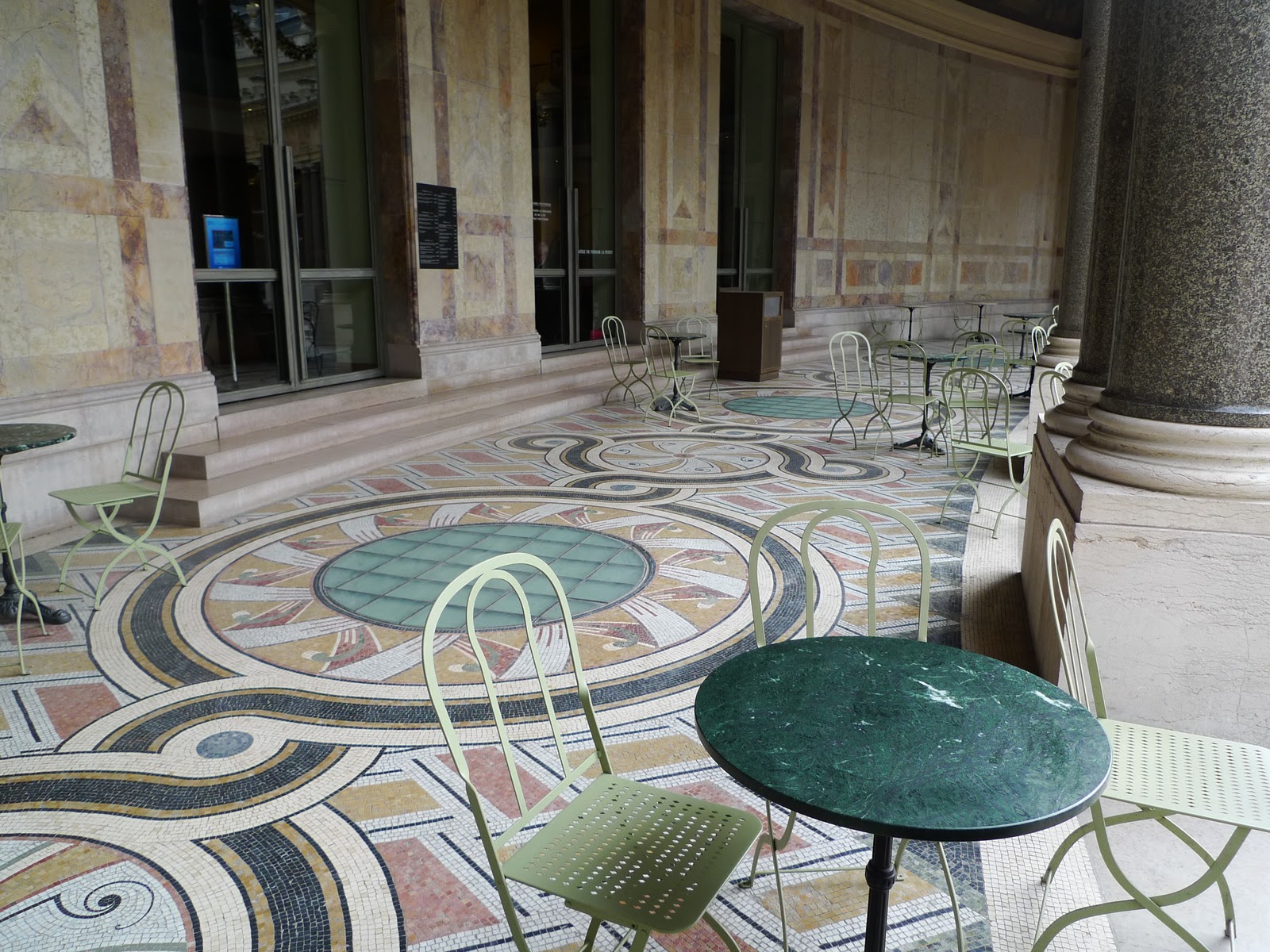
 There is a place to sit and eat at the café restaurant. The outdoor sitting area is much desired by most on a lovely day. 
Art objects are displayed indoors and outdoors and there are bronze statues scattered in this area.  In this same picture, you can see the mosaic floor design.  There are others just as beautiful in the other parts of the Petit Palais. 
Look up and see the painted pattern on the ceiling.
This place fills up on good-weather days in the spring and summer, especially on the weekends. People come to meet, to walk around the courtyard and be delighted by the beauty around, or just to enjoy taking the sun. Then, some take the time to see the exhibitions, too. Alot two to three hours to visit.

Back inside, it is typical to see groups of school kids here taking a tour as part of their art immersion program in school. Toward the back is the bookstore, and to the right is the entry to the Tuck Collection of 18th century furniture and furnishings. Here's a sampling:
l'art de Louie XV
Chaise a porteurs 1700-1715
(gold-leafed wood, sculpted and painted)    

A perspective view of the rest of the exhibit
Paravent      1735
Jacque de Lajoue
(Paris, 1686 - Paris, 1761)
Fauteuil à la reine     vers 1760-1775
(Queen's armchair with the same theme as the set of tapestries)
Groupe Le marchand de coeurs    vers 1738 -1750
Johann-Joachim Kändler
(Seligstadt ou Fischbach, 1706 - Meissen, 1775)
Ernest-Jules Renoux, artist
The objects he brought with him for outdoor painting: mounted parasol, leather/wooden stool, easel, canvass, water-color boxes, paint palett

It's time to descend to see the other collections.
This masterpiece was the work of some very talented students at the art academy.

The museum displays a remarkable number of collections - of paintings and sculptures and other works of art. There are paintings by Renaissance artists like Rembrandt, Rubens, Nicolas Poussin, Claude Gellee, Fragonard plus a host of others.
L'Enlevement de Prosephine    vers 16-14-1615
Petrus-Paulus Rubens
(Siegen (Westphalie), 1577 - Anvers, 1640)
Le Massacre des Innocents     vers 1626-1627
Nicolas Poussin
(Les Andelys, 1594 - Rome, 1665)

From the Dutuit Collection of medieval and Renaissance paintings, drawings and other objets d'art - 
 Doré et la tradition chrétienne XIXc collection:
La Vallée de Larmes
Gustave Doré 
(Strasbourg, 1832 - Paris, 1883)
 Le Christ
Léon Bonnat 
(Bayonne, 1833 - Monchy-Saint-Eloi (Oise) 1922)
La Vierge et l'Enfant      vers 1500-1504
Giovanni Battista Cima
(Conegliano, (?) 1459/1460 - Conegliano (?) 1517/1518)
Add caption
Vierge a la l'Enfant avec sainte Dorothee, sainte Catharine et deux anges musiciens 1500
Ecole Lombard

From the Renaissance Italie Collection
 La Vierge et l'Enfant, deux séraphins et la colombe du Saint Esprit
ATelier d'Andrea Della Robbia (Florence, 1435 - 1525)
Vierge a l'Enfant avec saint Jean Baptiste et deux anges    vers 1470-1530
Tommaso
Coffre de marriage
Le majolique Italienne  
(decorated earthenware)

And add to that some 19th century painters and sculptors including Ingres, Géricaul, Delacroix, Courbet, Monet, Isley, Pisarro, Cezanne, Modigliani, Carpeaux, Maillol, Rodin, and more.
From the Cezanne et la Modernité Paris 1900 collection:
Vieil Homme au Bâton 
Paul Gaugin  

(Paris, 1848 - Autona (Iles Marquises), 1903)
Baigneuses à Perros-Guirec
Maurice Denis
(Granville, 1870 - Saint Germain-en-Laye, 1943)

From the Monet et la Peinture Paysage XIXe Siècle Collection
Le Pont Royale et la Pavilion Flore
Camille Pisaro
(Saint-Thomas (Antilles Danoises) 1830 - Paris, 1903)

L'Eglise de Moret (Le soir) 1984
Alfred Sisley
(Paris, 1939 - Moret-sur-Loing, 1989)
Claire de Lune à Overschie (environ de Rotterdam) 1855
Johann Bathold Jongkind
(Latrop Overijsel (Pays-Bas), 1819 - Saint-Egreve (Isère), 1891)
Soleil couchant sur la Seine a Lavacourt 1880
Claude Monet
(Paris, 1840 - Giverny (Eure), 1926)
Le Départ de l'enfant prodigue     1863
James Tissot
Nantes, 1836 - chateau de Buillon (Doubs), 1902

Le Retour de l'enfant prodigue      1862
James Tissot 
(Nantes, 1836 - chateau de Buillon (Doubs), 1902)

     Les Funérailles de Charles le Bon, comte de Flandre, célébrées a Bruges, en l'eglise SAint-Christophe, le 22 avril 1127     1876
Jan Van Beers
(Lierre (Belgique), 1852 - Fay-aux-Loges (Loiret), 1927)
La Confidence     vers 1873
Jean-Baptists Carpeaux
(Valenciennes, 1827 - Courbevoie, 1875)

Guimard et l'Art nouveau Collection
Miss Ella Carmichaël     1906
Edmond Aman-Jean
(Chévry-Cossigny (Seine-et-Marne), 1858 - Paris, 1936)

The Petit Palais has the most extensive collective of icons. Here are a few pieces from the l'art de l'icon - Monde Chretienne Occidentale:
Vierge a l'Enfant avec saint Jean Baptiste, saint Bathélemy, sainte Madeleine et sainte Marguerite     Florence XVe Siecle
Attributed to Ventura di Moro 
Adoration des Mages     fin du XVe siécle
Flandre
La Cène     Greece 


Moyenne Âge et Renaissance
Left: La Nativite     vers 1525
Attellier de Niklaus Wechmann 
(Ulm, Allemagne du Sud)

Reliquaire de la Vraie Croix

(Reliquaries for pieces of the true cross)
Ssinte Marguerite     vers 1520
(Sud de la Souabe, Allemagne)

Monde Grec     Antiquité
Deux pleureuses     Debut de 111e siécle avant J.C.
( Production: Canosa)
Cratére en calice     ver 360e siécle avant J.C.

What I have featured here is just a minute fraction of what there is.  There are, literaIly,  hundreds and hundreds more. I apologize for the picture quality. The colors that came out were not always true colors due to the lighting and the reflection of the glass. 

Art pieces are appreciated more up close as you analyze the strokes, the colors, the texture, the theme, and get more sense and feel of the artist as you look each piece. Art appreciation is the beholder's feedback - you finish the painting, the sculpture, or any other objets d'art  with your thoughts and lasting impressions.

You can rent an audioguide or opt to join a guided tour. There are printed guides in most sections.
On exhibition now is Jean-Louis Forain (1852-19310 'la Comédie parisienne' from March 10 to June 5, 2011. Jean-Louis Forain was a satirist. He delivered his messages via his artistic expressions about the bourgeoisie and the less desirable aspects of Parisian society. The exhibition unveiled more than two hundred of his works in oil, watercolors, pastels, engravings and drawings. From Impressionism to Expressionism, his themes were most always about everyday life.

You are all invited to come and see this one. 

Petit Palais

Avenue Winston Curchill 75008 Paris

Open Tuesday - Sunday, 10:00 a.m. - 6:00 p.m.

METRO Stop: Champs Elysées/Clemençeau

LinkWithin

Related Posts with Thumbnails