Saturday, 1 April 2017

Butanding Sighting in Donsol, Sorsogon, Bicol, Philippines

While in Bicol, we wanted to experience something extraordinary: to swim with the Butanding whales. Well, not really for all the members of our group, where only three out of ten bravely decided to do it while the rest would just watch and take pictures. And so we booked with an agent to go to Donsol in Sorsogon.

Donsol was settled by refugees who were running away from Mayon Volcano's fiery temperament  in the late 18th century. How its name came to be has two versions. There is an indigenous plant that grew abundantly, which happened to be medicinal, called "donsol' or "dosol." Another version is, its name was derived from a blacksmith's skill who uses an iron stand upon which he pounds, and in the process creates tools and weapons from the red-hot iron. In the local vernacular, the iron head is called "dosolan."  

The success of this rural town is in how it has become the "benchmark for ecotourism ventures in the country."
It paid off to go early. We were the first group in line. By the time the tourist center opened, there was already a large number of people. We wanted to be among the first ones to go out.

In Sorsogon, Bicol, Donsol is one of the places in the world that offers the unique experience of swimming with the Butanding whales. The whale sighting season is from November to June, with a peak period for tourists from February to May when more sightings are expected. One advantage of experiencing this in the Philippines is how reasonable it is in comparison to other resort centers in the world that offer this. The package cost is less than a hundred U.S. dollars. And if you are lucky to avail of a promotional package price, it can go down to as low as $40.00 per person.

The first thing to do upon arrival is to register at the Donsol Visitors Center in Barangay Dancalan. The fee is 100 pesos for the locals and 300 pesos for foreigners.

The package prices vary, depending on who you book with. Included in the package is the boat ride, a life vest, a BIO (Butanding Interaction Officer), and a spotter. For those planning to swim, there are stores renting out the needed gears and fins for snorkeling. 
After registration, there is a short film to watch, to familiarize the visitors on how to properly interact with the butanding whales. Interaction with the whale sharks is regulated by the local Department of Tourism. 
Our boat is ready and waiting for us.
 Our BIO gave us the final instructions on how to prepare for getting into the water, plus a recap of how to behave around the whales.

Butandings are identified as "whale sharks" (Rhincodon Typus). They are large tropical sharks - the largest known fish that swim to the surface in warm waters, making it possible to see them easily.  They have small teeth and their diet consists of plankton which they strain with their gill rakers. They can grow to as long as 60 feet (18.3 meters). 

Although, they have been around in Donsol for a long time, the locals believed them to be dangerous. Fishermen used to shoot them when they got caught in their fishing nets. They were the victims of poachers, too.

It was not until 20 years ago when a possible interaction with the whale sharks was discovered. There was a group of scuba divers led by Romir Aglugub - a PADI (Professional Association of Diving Instructors) diving instructor. On December 26, 1997, he came to notice the presence of the Butandings and interacted with them. He led the other divers with him into the water, who were, at first, not sure whether it was safe to interact with these whale sharks. From that encounter, a video footage was taken. This video was passed on to the media and WWF-Philippines (Worldwide Fund for Nature). This became the basis for how Donsol became known as a world-class site to experience swimming with the Butandings.

To protect the sharks, the WWF set guidelines: boat capacity allows up to 6 swimmers using only snorkeling equipment; scuba divers are not allowed; keep a distance of, at least, 3 meters from the sharks.

Donsol, Sorsogon's whale shark sightings were featured by Time Magazine in 2014 and was rated as the "Best Animal Encounter in Asia."

 It was a good sign to see other people already in the water. This meant that there had been a sighting of the whale.

 Our spotter - our look-out man,  is at his post.

 We got into ready position to jump into the water upon getting a signal from our guide

 A missed first attempt

With a rented underwater camera, our guide was able to take pictures of the giant, gentle creatures...here is one of them.
Donsol, located in the province of Sorsogon in the Bicol peninsula, has become the "Whale-Shark Capital of the World" in the last decade or so, thanks to the presence of the butandings which are referred to as the world's biggest fishes. This place has become a sanctuary for the butandings because of the abundance of krill and plankton in her waters, coming from two rivers in Donsol.

 At the top of this picture was a Butanding (now underwater) that flipped its tail to say "goodbye." What  thrill!

Though, we didn't get to swim with the whale sharks, we at least, got to experience a butanding sighting. 

And for those who get the chance to interact closely with the butandings, noticeably, is their wide mouth (sometimes up to two meters wide) lined with thousands of tiny teeth. But it is in the gill rakers, after the water is sucked in through their mouth, where the food settles, as they feed on the krill and plankton.
Back at the center, we went straight  to the bath house to shower and have a quick change. Then, we chose a spot under the nipa roof to enjoy a catch of the day by a local fisherman...
...crabs that we had cooked - steamed, and eaten with a concoction of vinegar, garlic and salt, with steamed rice, along with other Bicolano dishes.

We just spent a couple of hours in Donsol, however, there is more to experience here, such as the Evening Firefly Tour at Ogod River; the Donsol River Cruise or the Shrimp-Catching Night Tour which gives the visitors a good look at aqua farming. 

Donsol is just one among the wonderful places to visit in the Bicol region.

Monday, 20 March 2017

The Cagsawa Ruins and Daraga Church in Albay, Bicol, Philippines

The Cagsawa Church was originally built by the Franciscan friars, under the leadership of Saint Pedro Bautista in 1587, during the Spanish occupation of the Philippines. San Pedro Bautista was the first bishop of Nueva Caceres (Naga). 

A note about San Pedro Bautista...he arrived in the Philippines from Spain in 1584, as part of the fourth wave of missionaries to the country.  His first assignment was in Intramuros, where he also ministered to the Japanese living outside of Intramuros, and with the help of Fray Gonzalo Garcia, they organized the Filipinos into "town settlements." 

In 1586, he was transferred to become the parish priest in Lumban, Laguna. There he taught church music and the making of musical instruments. 

In 1590, he established the Franciscan novitiate in San Francisco del Monte.

He discovered the medical attributes of the hot springs in Los Baños. He defended the basic human rights of the indigenous people in Zambales, inculcating in the minds of the people the value of human life.

in1593, he became the Philippine ambassador to Japan, where he, successfully, averted the emperor's plans to invade the Philippines. He settled in Miyako along with his companions, then moved to Nagasaki where they established hospitals and churches. The emperor began to persecute Christians in 1596, and San Pedro Bautista was among the twenty-six Christians -  four Spaniards, one Mexican,  who were all Franciscan missionaries; three Japanese Jesuits;  seventeen Japanese laymen; and three young men who were members of the Third Order of St. Francis - who were crucified and speared to death on February 5, 1597 in Nagasaki. The Martyrs of Japan were canonized by Pope Pius IX on June 8, 1862. They are listed in the calendar of saints as Sts. Paul Miki and his Companions, and commemorated on either February 5th, 6th, or 13th by different Christian denominations.

This image has become so famous as it is used in posters to promote tourism in the Bicol region.

The architecture of this Franciscan designed church had one belfry, with a convent attached to the church, along with some patron and venerated saints like San Francisco, San Antonio, San Pascual Baylon, San Buenaventura, Nuestra Señora de los Angeles and more, in the interior of the church.

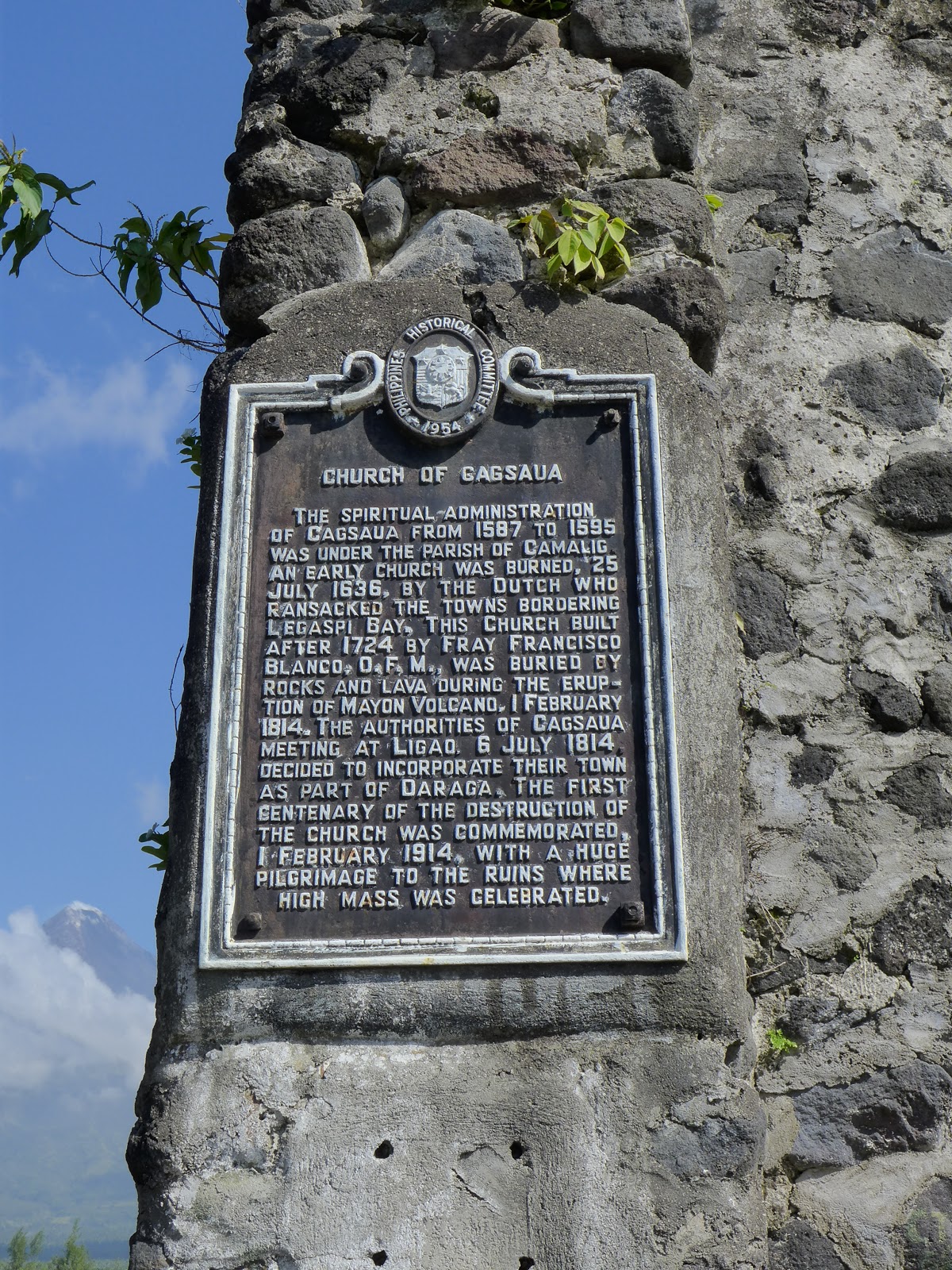
The church was rebuilt in 1724 by Fr. Francisco Blanco, after the original church was burned down by the Dutch in 1636, when they attempted to invade the Philippines during her Eighty Years War with Spain that began in the 1500s.

On February 1, 1814, Mayon Volcano became active, which turned out to be a deadly eruption. The church was destroyed and about 2000 inhabitants from the surrounding areas were killed when they went to the Church to seek shelter and protection from the volcanic eruption, as the dense mass of very hot ash and lava, along with explosive gasses from the volcano flowed down  at a very fast speed. 

Though, the church facade survived, several volcanic eruptions almost leveled it to the ground in the 1950s. What remains today is the bell tower and some parts of the convent, with an imposing background of Mayon Volcano.


What was once the Cagsawa church, is now known as the Cagsawa Ruins Park, in Barangay Busay, in the municipality of Daraga, Albay, in the Bicol Region. 

The park is the site of the Cagsawa branch of the National Museum of the Philippines, where geological and archeological exhibits and pictures document the history of the volcanic eruptions.
Mayon Volcano at midmorning, with a ring of cloud formation that appears after 7:00 in the morning.


This is a view of Mayon Volcano early in the morning, with a noticeable smokestack, which we discovered during an early-morning walk near our hotel. 

In July of 1814, the local officials decided to incorporate their town with Daraga. Thus, the local townspeople had another place of worship to go to - the Daraga Church.
 Daraga Church - Our Lady of the Gate Church

Under the patronage of Nuestra Señora de la Portería 
(Our Lady of the Gate)


The church is distinguished by its striking facade, with elaborate Baroque elements. The architecture features "solomonic columns, flowing cornices, and bas-relief images of saints and religious seals carefully carved through the entire face of the church." 

It was built atop a hill by the Franciscan Friars in 1773, with the use of volcanic rocks. A coating of lime has been painted on the volcanic bricks to protect them from the elements.

 A message from Our blessed Mother...

Nuestra Señora de la Portería 
(Our Lady of the Gate)
 A prayer to Our Lady of the Gate


The other venerated saints

 A painting of Nuestra Señora de los Angeles in the Cagsawa Church

 A depiction of the exodus of the local people during the destructive eruption of Mayon Volcano in 1814

 The austere church interior

The Cagsawa Ruins (also referred to as Kagsawa, Cagsaua) has become one of the iconic places to visit in Albay. From there, it is but natural to continue on to the Daraga Church, to continue the story of the plight of the people as a result of the fiery temperament of Mayon Volcano.

Monday, 30 January 2017

La Giralda Tower, Seville, Spain

After our visit to Plaza de España, we went back to where we had started our walking tour of Seville, at the plaza in front of the cathedral and the tower. 
The La Giralda tower is not to be missed, while visiting Seville, Spain. At the top, it is a lovely, panoramic view of historic Sevilla.  La Giralda is one of the iconic landmarks  that rises to a height of 103 meters.
La Giralda was the minaret of the Alijama mosque that was built in 1195, used to call the faithful to prayer. It was significant in the Islamic faith and was given much importance by the Moorish rulers.  The completion of this tower took twelve years. It is is an example of Almohad architecture, which took hold in Seville after the reconquest of the city by King Alfonso X in 1248. The Moorish rulers wanted to destroy it rather than have it be used as part in the practice of another faith, but they were threatened to death by the king should any attempt be made to take even just one stone. Thus, it was eventually turned into the bell tower  of the Cathedral of Seville.                                                                                                                                                                                                                                                                                                                                                                                                                                                                                                                                                                                                                                                                                                                                                                                                                                                                                                                                                                                                                                                                                                                                                                                                                             

It takes its name from the Spanish word girar - to turn. Giralda means "she who turns." At the top of the tower was a weather vane of El Geraldillo - representing faith in the four corners of the world.
A view of some of the Gothic features of the cathedral as we entered through this key-hole designed portal
We dared to climb the tower and it turned out to be worth it.  It was a climb that involved going up 35 inclines with ramps. This was used by the muezzins - the guards who went up to the top, two at a time, riding their horses or donkeys to call the faithful people to prayer. 

ON OUR WAY TO THE TOP
Looking out the windows

The tower was built with red bricks, with beautiful trellis designs forming the windows with a series of arched niches. Each side of the tower showcased a different trellis design. In the original design as a minaret, the tower was crowned with four copper balls and topped with a crescent moon. In the mid-14th century, an earthquake destroyed part of the tower and it was restored with a bell tower and a cross. 

The tower was consecrated as a Christian church in 1248 and used as a cathedral until it was restructured to be the tower next to the construction of the cathedral of Seville. In the back are the leaves of a 14th century door that is believed to have been part of the Sagrario Chapel, with Gothic writing and verses from the Qur'an.
In the 16th century, the upper portion of the bell tower was renovated to four-storeys, with a weather vane on the top. 
A replica of the weather vane displayed on the grounds of the cathedral

The finished structure was a blend of Moorish and Renaissance architecture. 
 The belfry at the tower

THE VIEW FROM THE TOP - HISTORIC SEVILLE

The Courtyard - view from the top
The courtyard between the cathedral and the tower planted to orange trees - an original feature of the minaret
The drain system in the courtyard dating back to the 12th century

View of the Archbishop's Palace to the left

One of the doors in the minaret, now part of a collection of artifacts on display

Our exit point

While looking from the ground level at the cathedral and the tower next to each other, there is a noticeable difference in the materials used in their construction. According to our tour guide, the use of the bricks in La Giralda was a reflection of the belief in Islam that worldly things will not last forever, while the use of stones in the cathedral signified a solid foundation in our faith in God.

Next on our agenda to visit was the Cathedral of Seville.

LinkWithin

Related Posts with Thumbnails