Showing posts with label Bernini. Show all posts

Friday, 7 January 2011

Rome: Part 8 - Fontana de Trevi

The Fontana de Trevi (Fountain of Trevi) was the basin for the aqueduct that was commissioned by Caesar Octavian Augustus and was built by his son-in-law Marcus Visapnius Agrippa, in 19 B.C., for the purpose of bringing water to the thermal baths in Rome. There is a long history about this fountain being built, falling into disrepair, being rebuilt and renovated, including the involvement of several popes who took interest in them from 1433 to 1730, for self aggrandisement.

Pope Clemens XII, the last pope to take on this project, had a design competition for the new design of this fountain, in 1730. Nicola Salvi garnered the top price, for the reason that his was the most economical. In 1732, the project began. It was funded by proceeds from the Italian lottery. Although the fountain was not yet completed, Pope Clemens XII inaugurated it in 1735. This project took about 30 years to complete. It went from Clemens XII to Benedict XIV, and finally completed under Pope Clemens XIII.
In 1759-1762 Pietri Bracci carved the "Ocean of Triumph" in marble, as designed by Salvi, who had passed away in 1751. Bernini got involved, to resite the fountain to face the Quirinal.  Giuseppi Panini took over the project upon Salvi's death and finished the fountain in 1762.

On May 22, 1762, Pope Clemens XIII inaugurated the fountain which remains as it is, up to today. At the top of the attic, is the papal crest of the pope who restored the fountain.
The palazzo behind the fountain makes for a good back drop for this fountain. It was bought by the city in 1885, and it now houses the National Institute of Graphic Arts.
The main feature of the marble "monument is a chariot in the shape of a shell, drawn by seahorses with Triton as their guide." The central figure is "Oceanus." On the left is the statue of "Abundance" and to the right is "Health."All around the fountain's boarders are "representations of rocks and petrified vegetation...which represent the sea." 

Whether you come in the daytime or in the nighttime, this Baroque fountain is just as beautiful and impressive. In the nighttime, the lights give it a dramatic effect with the play of light and shadow and the glistening, running water.
This beautiful fountain has been immortalized in such movies as "Three Coins in a Fountain" and "La Dolce Vita" by Fellini.

The practice of throwing coins by the Romans in the fountains, rivers, and lakes started in the ancient days, to win the favor of the gods of water for a safe journey and a safe return. Now, the tradition continues to maintain the fountain. About 3,000 euros in coins are collected each day.  

They say that if you throw a coin in the fountain, you will return to Rome. I threw my first coin in 1971, and it worked! If you want to go to the Trevi Fountain, right now, click on the hyperlink and take this virtual tour. Arrivederci

Tuesday, 21 December 2010

Rome: Part 3 - Sunday, on the Piazza with the Pope

For Roman Catholics, the Vatican is a major pilgrimage destination. It is where the Holy See is, where the pope - the successor of Peter, resides as the bishop of the diocese of Rome.

This square in front of the basilica was redesigned by Gian Lorenzo Bernini from 1656 to 1667. It was precisely designed so that many people could see the pope give his blessings, either from the forefront part of the façade of the church or from one of the windows in the Vatican Palace.


Part of the Vatican Palace rises behind the colonnade. Bernini, who had been working on the interior of St. Peter's for decades, was also asked to reorganize the open space. Included in his plans was designing the colonnades, in Doric style.

Here, the pope's coat-of-arms design is perched up at the beginning of the colonnade structure.
Bernini made the fountains as the foci of the ellipse-shaped piazza, with the colonnades looking like arms about to embrace them.
My family and I joined the rest of the people gather around, after hearing the 11:00 a.m. mass, at St. Peter's square, in anticipation of the pope's appearance at about noon time. It was a Sunday, and Sunday is the day of the week when Pope Benedict communicates with the pilgrims in Rome, on the square.

At the center of the piazza stands an Egyptian obelisk of red granite, used as a centerpiece for the piazza by Bernini.
I call this point zero, from which one stands to see all the columns in the colonnade become a waved wall with no spaces in between.
The crowd applauded as the flag was let down, indicating that the pope would be making an appearance, soon.
When the pope showed up, the people welcomed him with a warm applause, some waving their white handkerchiefs, and group banners were propped up to be seen. It was the pope's turn to welcome us. He named the countries from which groups of pilgrims came from, delivered his brief message in different languages, blessed the religious articles and then he gave his blessings.
Soon after, the people - feeling blest to have been present for the pope's blessings, began to disperse, some through Villa Della Concilazione, and most likely heading to lunch at a place, nearby, or to do more sightseeing.

We were getting hungry and we decided to go to Hotel Columbus, which was just about a 10 minute walk. Let me tell you - this place was beautiful!

Sunday, 19 December 2010

Rome: Part 2 - The Christmas Season at St. Peter's Basilica at the Vatican

When in Rome, visiting the Vatican is always a must for me, as this is the seat of my faith. Two years in a row, I have had the good fortune of coming to visit this place at this time of the year.


On the way to Vatican City

At St. Peter's Basilica, I am drawn back to the biblical history of when Peter was named as the first pope of our church, when Jesus commanded him to “Feed my lambs.... Tend my sheep.... Feed my sheep”.


On Villa Della Concilazione, entrance to the piazza with the basilica in the background, created by Benito Mussolini.

Walking towards the basilica

A perspective look at the nave of the basilica

The first thing you will notice is a crowd gathered at a side altar to the right of the church, as they view Michelangelo's "La Pieta."

Font for the holy water

Notice that on the sculpture of St. Peter the toe-details of one foot have been smoothened out as pilgrims have continued to prayerfully touch it through all these centuries.

Many biblically-themed "paintings" adorn several side altars. The original paintings were removed during the last world war and, today, they are very intricate mosaics that pilgrims get to look at. Hard to believe? Look closer and you will see very small, colored tiles used to replicate the original designs.

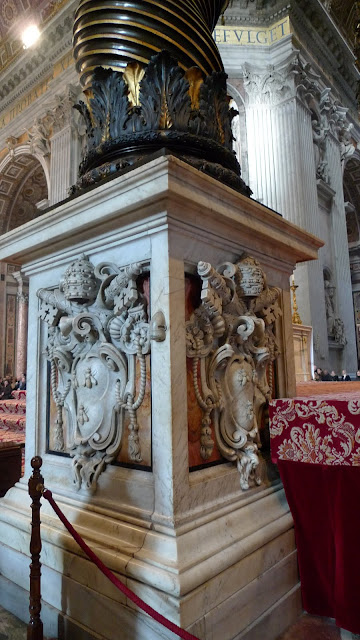
The Baldacchino is a masterpiece by Bernini. Directly below it, on the underground level, is the tomb of St. Peter.

The pope's coat of arms adorns the base of each column of the Baldacchino.

The main altar behind the Baldacchino, where only the pope can say mass

Ceiling detail above the main altar

The cupola


An archway from the middle part of the nave, leading to the side of the cruciform layout, where several small chapels are located.

The manger scene from last year's display, under the changing colored spotlights...

as seen in regular lighting.

This time, we decided to visit the Vatican Museum. Upon entering from the inside of the church, the Eucharistia, the list of popes really impressed upon me the solid link of the Roman Catholic Church to Jesus Christ, from His first appointment of St. Peter to the present pope.


I was eagerly looking for the manger scene display, this year, but this was all they had, so far.


Out on the piazza, a giant Christmas tree stands close to the makings of a manger scene. On Sundays, this place fills up with pilgrims from all over the world, who come to see and listen to the papal address.

We'll be back on a Sunday, then.

LinkWithin

Related Posts with Thumbnails