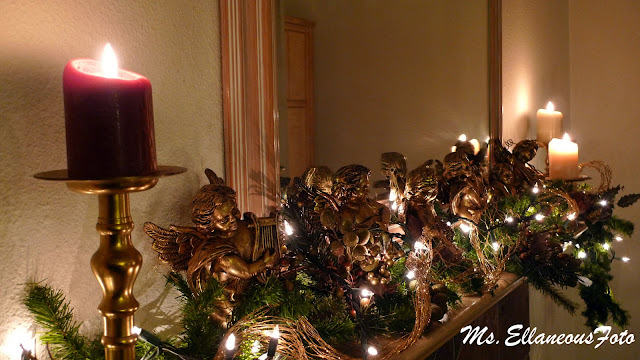
A visit to Roger's Gardens in Newport Beach, California is like going to a holiday fantasy land. Themed Christmas trees, wreaths and holiday accoutrements are displayed to feast on and draw ideas from.

Natural or fabricated, the holiday items certainly make delightful Christmas eye candies.

Taking a look at the decorating details gives one ideas as how to decorate just about most parts of the house and how to use everything you may find in your own home.

A unique way of decorating - large metal trivets have been positioned about a foot apart from each other, vertically to the tree trunk, making them the perfect aid to hung the ornaments from.

The Christmas tree themes range from the holiday designs of the winter season, hobbies and professions...

to the Holy Family.
Christmas collectibles are a big thing among the clientele here.

Father Christmas started out as a European tradition. The true-to-life character behind this figure is St. Nicholas - a bishop who lived in the 4th century in the former Asia Minor Territory of Myra, which is now our present-day Turkey. Orphaned at a very young age and left with a fortune, he grew up to be a kind man who devoted his life in the service of God. He earned a good reputation as he was known to help the poor, giving secret gifts to people in need. He became legendary during his time.
One popular story told about him suggests the origins of when hanging stockings became a practice at Christmas time. There was a very poor father with three daughters who could not get married because he could not afford to give a dowry. Once St. Nicholas found out about this, he dropped a bag of gold down the chimney into the poor man's house, that landed straight into one of the stockings hanging to dry. This enabled him to marry off his eldest daughter. Again, the same thing happened a second time, enabling the middle daughter to get married. Wanting to find out who the benefactor was, the father hid every evening until he saw St. Nicholas, one evening. Even after St. Nicholas had begged for the man to say nothing about the incident, the word got out. Everyone concluded from then on that when anyone received a secret gift, it was assumed that it was from St. Nicholas.
St. Nicholas was canonized a saint. He is considered the saint for children and for sailors. The miraculous survival of some Turkish sailors who prayed to him while in the midst of a terrible storm is attributed to His intercession, as he appeared on the ship's deck and commanded the sea to be calm.
St. Nicholas was a victim of Emperor Diocletian's persecution of Christians. He was banished and imprisoned away from Myra. It is believed that he died on December 6 in the year 345 or 352 AD. His bones were stolen from Turkey by an Italian merchant sailor. His remains are now housed in the Basilica San Nicola in Bari, Italy. On his feastday which is celebrated on the 6th of December, the sailors of Bari carry his statue out to the sea and petition him to bless the sea that they may all have safe voyages all-year-round.
The traditions regarding St. Nicholas waned in the 16th century. The gift giving role of St. Nicholas was taken over by other figures to deliver gifts to the children at Christmas time. In England, the character of "Father Christmas' from old children's stories, replaced the legendary and traditional gift-giver, St. Nicholas. In France, he became known as "Pere Noel," and as "Christ Kind" in Germany. In the early days of the United States, he was known as "Kris Kringle." Eventually, the Dutch settlers who brought the traditions of St. Nicholas with them. changed Kris Kringle to "Sinterklass" which we now say as "Santa Claus."
Still to this day, December 6 is celebrated as St. Nicholas' Day in Europe. Children leave their clogs or shoes to receive presents. St. Nicholas' popularity was rekindled with the publication of a poem during the old Victorian era entitled "A Visit from St. Nicholas" or "T'was the Night Before Christmas," in 1823. From this came the song "Rudolph the Red-Nosed Reindeer" in 1949.
Father Christmas figures in the European traditions continue to be popular among collectors.
Creations from Byers' Choice LTD - a handcrafted American tradition


Byers' Choice Carolers
What started out as home-made Christmas decorations have now become known as the Byers' Choice Carolers.
It was in the late 1960s when Joyce Byers decided to make her own
holiday decorations that reflected her memories of Christmas. With a
degree in fashion design, she easily came up with her own original
designs using some fabric scraps, a part of a fur coat that belonged to
her mother, cut hair from her children, a coat hanger, plus plaster and
some paint. What she came up with were figures of Christmas carolers
dressed in plaids with cheerful, singing expressions. The first set of
carolers she made were set up in the dining room table that Christmas
and she received so many compliments from those who got to see them,
mostly her relatives. The following year, she decided to make more
carolers to give away as Christmas presents.
A
neighbor had suggested to Joyce to take some of her original Christmas
carolers to a local store which was part of a Federation of Woman's
Exchanges, and right away they sold. Soon, Joyce's items were introduced
to other exchanges all over the country, and orders for more poured in.
Joyce
asked the help of her husband and 2 sons to fill the orders, by helping
her make the products in the dining room, to be ready by autumn. With
the downturn in the economy, Bob - Joyce's husband, saw the potential in
making the carolers into a full-time business, thus it became in 1978, as they hired their first employee and turned their garage
into their workshop. After college, the two sons also took key positions
in the company. A team of 180 trained artisans in Pennsylvania now work
the production line.
The carolers, with their distinct look and handcrafted quality have become collectibles through the years. Carried in fine gift stores in many parts of the world, the company - since day one, continues to produce their unique Christmas line of products at an affordable price. At Roger's Garden, a special presentation by the Byers representative introduced the 2012 holiday line of the carolers, plus their Advent calendars, at the start of the holiday season.
Collectible Nutcrackers
Invented by the Greeks more than 2000 years ago, the nutcracker is a device used to crack open the shell of a nut to get the meat inside. The decorative nutcrackers began to appear in Europe in the 16th century. An Erzgebirge wood craftsman, Fuechtner, was the first to design a decorative nutcracker in the mid 19th century.


The Steinbachs, originally from Austria, had moved to the town of Erzgebirge, Germany, around the 13th century. This family of successful professionals had been threatened by wars and religious persecutions during the medieval age. After they established themselves in Germany, life was good for them in Erzgebirge, until the mines dried up in the 18th century.
Erzebirge means "Ore Mountains" as it was rich in metallurgical deposits. It's harsh weather conditions are enfluenced by the cold Russian winds from the east. Its picturesque countryside of castles, snow in winter has made it a popular winter, holiday, destination. Their traditions were brought in by the early settlers in the 13th century.
The cultural traditions in the Ore Mountains were shaped by the mining industry that dates back to the middle ages, in the different aspects of their lives - from the landscapes, lifestyle, handicrafts and folk art, and cuisine. Their customs and traditions at Advent and Christmas time are showcased in their mountain folk art - in their "smoking figures, Christmas pyramids, candle arches, nutcrackers, miners' and angels' figures," which they all use as decorations. Traditional Christmas mining celebrations, Mittenschicht and Hutzenabende, have been visitor drawers during the holiday season, as the Ore Mountains turn into Weihnachtsland (Christmasland). Christmas markets and other folk festivals are also part of the Christmas traditions.
Back to the Steinbach family, it was under Herr Christian Steinbach that their companies in Hohenhamelin in Northern Germany and Marienberg (built after the fall of the Berlin wall) had flourished. The Steinbach nutcrackers and other wooden collectibles have been produced in the last, almost two hundred years. With the passing of Herr Christian Steinbach in 2007, his daughter Karla - a sixth-generation Steinbach family member, took over the reigns of the company, Steinbach GmbH. Last November 30, there was a signing event at Roger's Garden with Karolin Steinbach.
The traditional Erzgebirge nutcrackers are designed after authoritative figures from the18th and 19th centuries, like policemen, kings and soldiers. What made the Steinbach nutcrackers appealing to a worldwide audience was the range of design that included famous people, legendary characters, literary and folkloric characters, as well. For the U.S. market, portraits of generals and some U.S. presidents have been added.

The Ulbricht family - another family from Erzgebirge - has been in the business of making nutcrackers, since 1928. Their line goes as far back into the 17th century, where their roots can be traced in the German village of Erzgebirge, known as "Ore Mountain" rich in gold, silver, and tin deposits. It was a wealthy community of miners whose hobbies included wood turning. When the mines dried up in the 18th century, the miners turned their wood-turning hobby into their sources of livelihood, making nutcrackers, incense smokers, Christmas pyramids, candle arches, wooden music boxes, and other figurines and ornaments.
Otto Ulbricht was a very talented wood turner. He had set up his business in 1928. He had a successful business, had moved to Seiffen to have a larger factory, but had to move again at the end of World War II in 1945 as his factory was on the East German zone, under Soviet control. He and his family relocated to Bavaria. Upon his death in 1968, his son Christian successfully took over the business. With the fall of the Berlin wall, the family property in Erzgebirge was regained.
With factories in Erzgebirge and Bavaria, Christian Ulbricht had added new designs to the nutcracker line, aside from the traditional designs of kings, soldiers and policemen. His nutcracker line includes the more modern designs, such as the mouseking, George Washington and Teddy Roosevelt, Pope Benedict and Martin Luther.
Other third generation members of the family are now active in the business. Inge Ulbricht, apart from designing most of the ornaments, is in-charge of production in the Seiffen factory. She and her brother, Gunter, organized the Christian Ulbricht Collectors Club in 1998. Gunter Ulbricht, who inherited the family's creative genes, is responsible for most of the nutcracker designs now available. A signing event was organized last December 8th. Gunter made a personal appearance at the garden, met and personally signed the pieces chosen by the guests.
Glass ornaments

Ne'Qwa Art Ornaments
In Mandarine, Ne'Qwa refers to the "artistic tradition of reverse painting on the inside of mouth-blown glass." This art form flourished in the 17th century when snuff bottles were in vogue in China.
There are only a few groups of Chinese artisans living in remote villages who are skilled in the art of reverse painting. Ne'Qwa Art, which was co-founded by Jim Sexton - and who also happens to be their head designer, aims to revive this ancient art form tha is over a thousand years old, with the collaboration between internationally known artists and the Chinese artisans.
Ne'Qwa Art has its own art school in China. There they train new artists in the painting tradition hat has been passed on by the Chinese artisans.
The Ne'Qwa Art Ornament event was held last December 9 at Roger's Gardens. Trieste, the only American artist trained in the centuries-old art form of reverse painting in glass, was on hand to personalize ornaments for those who came.
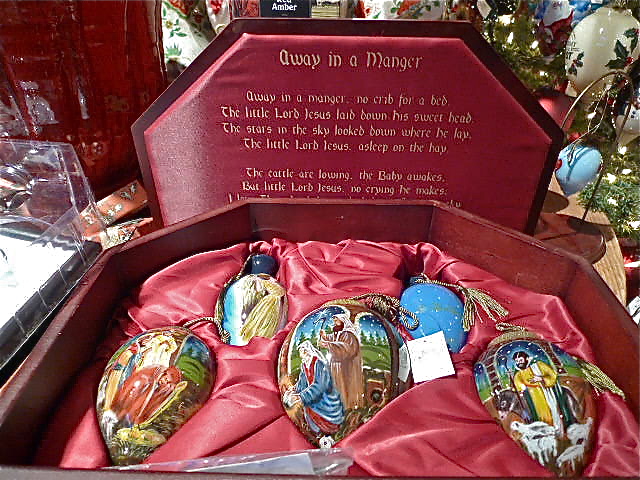
A set of Christmas-themed Ne'Qwa glass ornaments
This was my favorite set of Christmas ornaments. It told the story of Christmas. These pieces are works of art and are highly collectible at reasonable prices.
Bejeweled trees and globes

These creations are unique. Each piece is handcrafted with antique-looking jewelry pieces. Pricey at hundreds of dollars each.
The holiday look with plants

Ivory-colored poinsettias and white hydrangea

moss-covered containers

Wreaths and garlands

Poinsettias and Amaryllis in Christmas red


topiarys


garlands of lights for the trees and garden hedges
With just a couple of weekends before Christmas, you can still spruce up the house and the garden to give it that festive look. Keep it simply elegant!