Showing posts with label french macarons. Show all posts

Wednesday, 22 June 2011

Another Iconic French Institution - Ladurée

The year was 1862, when Louis Ernest Ladurée - a miller from southwest France, decided to open up a pastry shop on 16 rue Royale, in the neighborhood of la Madeleine. Jules Cheret, a "turn-of-the-century painter and poster artist" was given the task of decorating the shop. Inspired by the decorative styles of the Sistine chapel and the Opera Garnier, Cheret painted "Cherubic children" on the ceiling, as part of his design.

Madame Jeanne Souchard Ladurée came up with the idea of adding a Parisian café to the pastry shop, making it one of the first successful tea rooms. Drawing from her experience as the daughter of a hotelier from Rouen, Madame Ladurée founded a venue that attracted the Parisian society, including the women who came to gather, openly, among themselves. Pierre Desfontaines, a second cousin of her husband, was tasked to work on the expansion of the tea room in 1930.

It was also Pierre Desfontaines who invented the French macaron in the early 1900s, after a trip to Switzerland. He thought of getting two macaron cookies to sandwich a tasty ganache filling. Thus, came the first line of macaron, which was chocolate-flavored.
With the rich history of Laduree, this iconic institution attracted the Holder group. In 1993, Francis Holder and his son David successfully made a bid for Ladurée. As they designed to take this institution to new heights, a new branch was opened in September of 1997 on 75 Avenue des Champs Elysées, making it bigger and better. A renovation was embarked on sometime in 2008 or 2009 and was completed with new features added. 
David Holder, who is now the chairman of Ladurée, ensures the success of this iconic place by "adhering to traditional values and practices."
A section dedicated to the Ladurée specialties, like...
...their famous French macarons
...the Ladurée chocolate collection...
...the wine collection, including the Billecart-Salmon Champagne selected by Ladurée and gift-boxed goodies, like Orangettes (chocolates), Mendiants (chocolates), Tuiles (biscuits).
After the renovation, le bar was opened to the public.
The charm of the old world elegance was kept.
From being a patisserie that introduced the French macaron to the world to a Salon de Thé, to now in my list of must-go-to-places for family and friends who come to visit Paris, Ladurée is one of my most recommended places, not just for macaron but for good food and ambiance, as well. All under one roof you can choose to have tea, a serving of something sweet, a drink in the bar, or lunch or dinner.


After walking around the avenue Champs des Elysees - perhaps, even after climbing the Arc de Triomphe or coming all the way from Place de la Concorde, take a break and sample a...
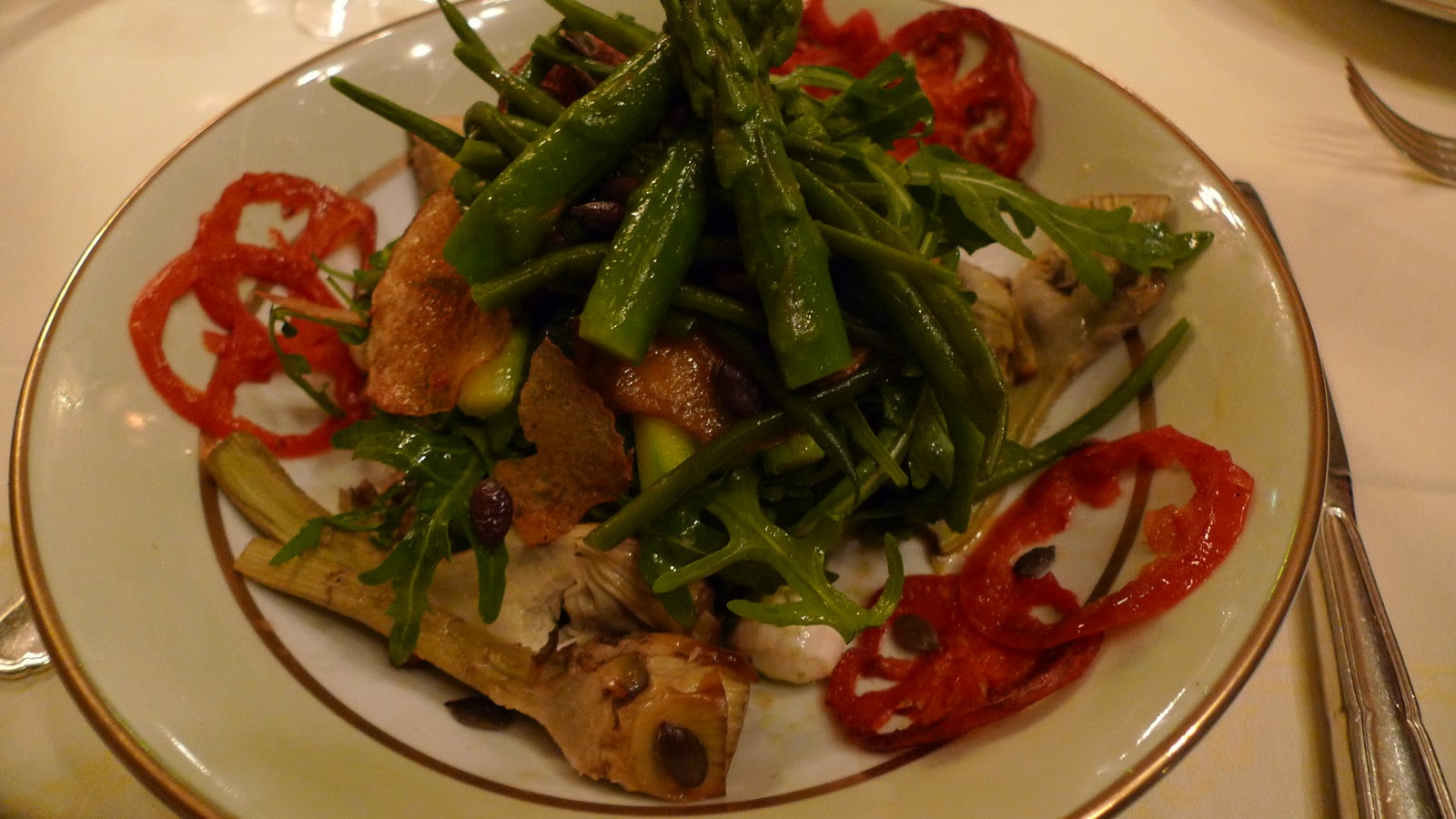
Ladurée Salad 
with Arugula, asparagus, grilled peppers and artichokes, and chips in citrus vinaigrette
Omellete 
with summer truffles
Ispahan
Two big framboise (raspbery) flavored macaron cookies filled with cream and fresh raspberries, topped with an edible rose petal
In summer weather, you may prefer to sit in the outdoor café, a perfect place for the smokers.

And perhaps you want to bring home something Frenchy to your love ones, like a box of macarons! Made daily, these macarons now come in a variety of flavors. Almond powder, egg whites, and sugar are the basic ingredients of the cookies. Then, two pieces are used to sandwich a flavored filling. With each new season, a new flavor is created.  
There is a rainbow of colorful flavors to choose from when you are ready to indulge in something that is delicately delightful, in fruity and floral flavors. Don't forget to also pick the flavor chosen to welcome summer - strawberry!

Just in case you are dying to have some macarons but never make it to Ladurée on Rue Royale or the Avenue Champs des Elysees, you can still find a Ladurée shop in different parts of Paris, and in shop-stands in some department stores and in the airport. And when you are traveling, there is one in Istanbul and one in Luxembourg. 

Allow the memorable taste of the macaron to linger in your palate and invite you back to Paris for more!

Sunday, 2 January 2011

Around Paris: Discovering Montmartre

Montmartre was our destination last weekend. With my daughter as my tour guide, I was about to discover much more about this area.

First stop: La Basilique du Sacré Coeur de Montmartre, or simply referred to as the Sacré-Coeur, to celebrate the feast day of the Solemnity of Mary, Mother of God.

The Sacré-Coeur basilica ( Basilica of the Sacred Heart) was built at the end of the 19th century at the highest point on Montmartre, Paris. "Montmartre" means " mount of martyrs." Tradition has it that this is the place of the martydom of Saint Denis, the first bishop of Paris (late 3rd century) along with his companions.

The building of the basilica came about as Alexandre Legentil and Hubert Rohault de Fleury vowed to build a church consecrated to the Sacred Heart of Christ, in reparation for the sins committed. When France faced defeat in the war with Germany in 1870, a part of her was occupied by German troops. As far as these 2 gentlemen were concerned, the country's problems stemmed more from spiritual rather than from political causes. 
To get there, we took Metro Line 2 from the Etoile station and we exited on "Anvers," then walked up to catch the funiculaire. It was nice to have this group performing at the street corner, playing New Orleans Jazz music while we waited.

Sacré-Coeur, with its famous white wedding-cake like architecture, spectacularly stands out in the city-skyline of Paris. It is a sight that welcomes you as you ride into the city, after landing at Charles de Gaulle airport.

As soon as we got through the doors beneath the cornice, the policy on "no picture-taking" went into effect. It was a solemn mass - meaning that the parts of the mass were sang, with very high attendance. During the homily, the priest referred to Mary as "a woman of prayer and deep faith." Soon after, tourists and churchgoers filed out to explore the rest of Montmartre.

From the church's steps, we could see a panoramic view of Paris. There were all sorts of entertainers and hawkers below, probably just like when Jesus went to the temple, and it upset him that it had been converted into a market place.

Its village like streets, its cafés and restaurants, its painters on Place du Tertre attract many tourists, especially on the weekends.

Performing all her French-hit songs, this performer was a crowd pleaser and gatherer. Her CDs were selling fast after every mini performance. She accompanied herself with an old-fashioned music maker, that uses perforated song sheets to create the background music.

Located on the north side of the Sacré-Coeur, the section where the Eglise Saint-Pierre de Montmartre, survived the French Revolution. The facade dates back to the 17th century and the bronze doors from 1980, by T. Gismondi.

Church interior - the church is built on a traditional Latin-cross plan, and is a mix of medieval and later styles. The nave is Romanesque, but is detailed with a 15th-century vault, flanked by aisles added in 1765 (north) and c.1838 (south).
The the choir ( not seen in this picture) has one of the earliest ribbed vaults in Paris (c.1147).

From the 12th century apse is this 20th century trio of stain glass, behind the main altar. Behind the altar is the tomb of Adelaide de Savioe, the nunnery's foundress and the mother of King Louis VI.
Among the themes on the stain glass windows...the cross and the Virgin Mary. 

As we walked a few meters away from the tourist area, going down little cobble-stoned streets, we discovered more churches, boulangeries (bakeries) and patisseries (pastry shops), café's, quaint shops, and other charming spots. This is really a lovely section of town with much to see and experience.

We stopped by for some macaroons. We rated them "very good!" If you want to try this place, come to 24 rue des Abesse 75018 Paris.

Because this church stood out, a different architectural style in the setting that it was in, we changed directions and went in for a visit. This is Eglise Saint Jean de Montmartre, situated at the foot of Montmartre. It is located at 19 rue des Abbesse 75018 Paris.

It was the first example of reinforced cement in church construction, built from 1894 through 1904. Architect Anatole de Baudot, a student of Viollet-le-Duc and Henri Labrouste, designed the church. "The brick and ceramic tile-faced structure exhibits features of Art Nouveau design while exploiting the superior structural qualities of reinforced concrete with lightness and transparency."

The Art-Nouveau stain glass was executed by Jac Galland according to the design of Pascal Blanchard.

When it comes to food, my daughter seems to be an expert. She said it was "a must to line up" at Le Grenier à Pain, because it was judged as the number 1 boulangerie for the best baguette! It is located at 38, rue des Abbesse 75018 Paris.

What to choose from this array of baked goodies was problematical. I went with the bread filled with apricots and goat cheese...loved it!

Here are the other bread products they make, aside from their famous baguette.

We stopped by here, too, on 40 rue Lepic 75018 Paris. Their vanilla, red-berries, cotton-candy flavored macarons were out of this world!

It had been a couple of hours since we got to Montmartre to hear mass and galavant around. Overfed and tired, it was time to rest our weary feet. But, we'll be back soon as there are more things to explore and to do here.

LinkWithin

Related Posts with Thumbnails