Saturday, 26 November 2011

Decorating for the Holidays


It's that time of year when we change gears and go into decorating for the holidays, from Thanksgiving to Christmas. A trip to Roger's Garden in Newport Beach, California,  made me think of how I was going to decorate the house to celebrate our favorite time of the year.
 Lots of ideas are presented here.


Decorating for the holidays goes back to centuries past. The use of light during the Christmas season has been  a tradition among Christian and non-Christian cultures.  In the mid 17th century, small candles were used to light up a Christmas tree. Glued with melted wax to the branches of the tree, they festively lit up the tree. 

When electricity was discovered n the 19th century, Edward H. Johnson - who had become the president of the Edison Electric Light Company, had Christmas light bulbs of red white and blue made especially for him, which he then hand-strung together. He headlined in the papers as having had the first electrically illuminated, revolving Christmas tree, which was pretty, elaborate, and entertaining to his children and his guests. He soon became known as the "Father of Electric Christmas Tree Lights."  

At the White House, President Grover Cleveland had the family Christmas tree illuminated with multi-colored light bulbs, in 1895. It was a luxury reserved for the wealthy as it is estimated that it cost about $2,000.00 to light up one Christmas tree, in the early 1900s, when General Electric started to market the Christmas light kits.

It took a fire in New York in 1917, due to the use of candles on the Christmas tree, for change to happen. Albert Sadacca, then a young man of fifteen years, was moved by this tragedy that he persuaded his family who owned a novelty lighting company to manufacture Christmas lights that were to be sold at a reasonably affordable price. First, sales were poor, but as electricity became a household utility, the use of electrical Christmas lights eventually became popular and part of decorating for the holidays. Albert and his brothers organized National Outfit Manufacturers Association in 1920 - a trade organization, which later became the  NOMA Electric Co. Their associate members, together, cornered the Christmas light market until the 1960s.

In 1932, the practice of lighting the National Christmas Tree on the south side of the white House to commence the holiday season celebration was initiated by President Calvin Coolidge. Then, with the stellar attraction of a lit up, giant Christmas tree at the Rockefeller Center in 1956, many more Americans got enthused to decorate for the holidays, indoors and outdoors. 

The trimming of the Christmas tree is a take off from a pagan practice. In the pagan tradition, boughs of evergreen branches were decorated with gold and silver and brought into the home to honor the winter solstice between December 20 and 23. As the days were getting shorter, the pagans feared that the world would come to an end. With the evergreens staying fresh, it gave them hope.

Our present-day tradition of decorating the tree dates back to the 16th century in Western Germany. It has different symbolisms for different people and faith traditions. In the Christian tradition, it is pointed to heaven above - a reminder to us to seek heavenly treasures more than earthly ones. 

For both religious and secular interpretations, it is the "Tree of Humanity." The decorated Christmas tree only became popular to the western world in the 19th century. From paper ornaments to glass balls and Christmas lights, they now come in a variety of themes as depicted by ornaments made from glass, plastic, resin, paper and other materials. Once only measuring about two feet and set up on the dining table, it was in America that decorating taller trees gained popularity.
 
 
The theme for the "reason for the season" - the birth of our Lord in the manger scene.

Collectors' items:
 
What makes an item collectible? For what reason does one start a collection? We all started collecting something when we were still young. When we look at what we have gathered, each piece brings back a memory.

In collecting Christmas ornaments, the artist's style is much liked by the collector. Each piece added to the collection, year after year, is carefully chosen based on one's taste. Some may collect from a singular  designer's work, while other's may collect from a number of designers. The collection maybe thematic or random, depending on what appeals to the collector. As time goes on, each piece is likely to bring back memories.  For others, collecting is an investment that they plan to cash in, in the future.
After visiting the Metropolitan Museum of Art in New York one Christmas season, almost 12  years ago, I was inspired to collect a Christmas nativity village. Through the years, I was able to add a major piece or two from the Fontanini Collection. This year, in place of the usual big, decorated Christmas tree, I have set up the nativity village in a cascading manner, in one corner of the living room. This design came to mind when I remembered the Church of the Holy Sepulchre in Israel, which was built around the different levels of the whole mountain side - where the markers of where Jesus was nailed to the cross, died, and was buried have been incorporated. 


At the top of my display is the Emperor's Pavilion under guard by a soldier, and below it is the census taker at the Census Building, then the village people going about their daily lives. Next to the right is the Holy Family with the Weaver's Tent above it.
The manger scene

The nativity of our Lord - the crèche, has always been the major theme and focal point in our Christmas decorations at our home. It is the retelling of the story according to the Gospels of Luke and Matthew.  Matthew 1:21: "She will bear a son and you are to name him 'Jesus,' because he will save his people from their sins.”

The commercialism of the celebration of Christmas is nothing new. During the middle ages, St. Francis was inspired to create a nativity scene when he saw some shepherds and their flocks on the hills in Greccio, Italy, and also his visit to the birthplace of our Lord in the Holy Land. He envisioned a live production of the manger scene - the birth of our Lord, to bring the biblical teaching about the birth of our Savior to the people, that they may have a deeper experience about the Christmas holiday being celebrated. This was to inspire the worship of Jesus.

He proceeded to Rome to get permission and Pope Honorius lll gave his consent for St. Francis' elaborate plan to recreate the nativity scene. With the help of a rich nobleman from Greccio, Giovanni, the production cost was funded. And so it came to pass in a cave in the countryside, in Greccio. People were hired to play the parts of  Mary, Joseph, the shepherds, with a life-size wax figure representing the infant Jesus. To complete the scene a manger, straw and live animals - the ox and donkey, were added, under the direction of St. Francis. In the meantime the local town's people noticed all the goings on on the countryside.

On Christmas eve, in 1223, the local inhabitants came to the hillside to worship, and they began to understand the meaning of the first Christmas in Bethlehem. Just like the shepherds, angels, and the three kings, they came to adore the Infant Jesus. According to St. Bonaventure's writings based on the eyewitnesses' accounts, St. Francis was overjoyed for the people, for the deeper religious experience they had gotten out of this.
The nativity scene, at Christmas time, is the most precious to me as it gives meaning to what the Christmas celebration is all about. We have St. Francis to thank for this tradition of displaying the nativity scene at Christmas time. It is a great reminder of God's love for us, when he sent his Son to be among us, to save us. 


This nativity set gets set up on my coffee table. When my kids were still young, I assigned each one of them to play the role of one of the magi. They took each king with them and they were supposed to travel and make it to the table on Christmas day. As I looked around a couple of days after, one king had landed on the bar, another one was behind the bedroom door, and one was by the front door. That was an interesting journey for the kings who eventually made it on time to join the shepherd and his flock, to adore the new babe wrapped in swaddling clothes.
In December, 2009, I had the blessing of visiting Rome. At St. Peter's Basilica, this manger scene displayed on the side of the church received center stage attendance among the pilgrims.


In the family room, I livened up some sections with... 
 Christmas village scenes - on a side table...reminiscent of the days we used to go up to Lake Arrowhead for the kids to enjoy some winter play in the snow...


and on my piano.


When I started decorating, I decided that I was not going to buy anything and will just have to do with what I had and could find around the house. For the snow cover, I used paper towels; for the mountain backdrop I used the paper bags from the super market - cut them out to lay flat, then crumpled them in no particular fashion and stretched them out to drape around the areas I wanted to cover. For the the piano winter scene, I sprayed the crumpled paper lightly with white paint in a well ventilated area.
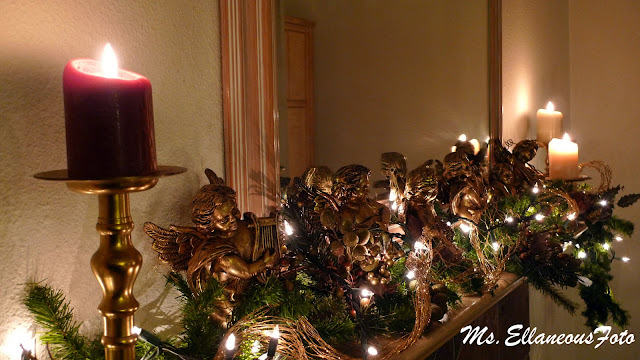
A choir of angels on my fireplace mantel

Decorating during the holidays helps put us in the spirit. For merchants, it attracts the consumers to their stores. However you prepare for the holidays, may it be a meaningful celebration for you and your family. Happy holidays and have a blessed, merry Christmas.

Sunday, 13 November 2011

Chef Gabriele Bertaccini - House of Balsamic

My schedule was set for Saturday, November 12, rain or shine, to attend an event at Roger's Garden, Newport Beach: Chef Gabriele Bertaccini of House of Balsamic was giving a presentation on the uses of balsamic vinegar  for  holiday cooking. Along with the others who came early, under some rain shower and nippy temperatures, we filled up the outdoor tent setting.

House of Balsamic, in partnership with Roger's Garden, had invited their resident chef -  Gabriele Bertaccini, to give us a better understanding of an ingredient that can make such a big difference in the taste profile of a dish.
 
When it was showtime, Chef Gabriele Bertaccini introduced himself. He is Italian and he is very passionate about food. After pursuing his studies in the culinary arts at the Professionale Buontalenti per Servizi Alberghieri, he specialized in Tuscan cooking. His cooking style is characterized by the use of fresh and tasty ingredients by means of simple cooking technics. 

After working in some regional restaurants, he took off for foreign lands to hone his skills further. He has traveled, lived, and worked in Paris, Munich, and back to Florence, and then, somehow,  he ended up in the U.S. He is the executive chef and owner of ilTocco, a private boutique-dinner-catering service for private functions and private events he organizes - Culinary Mischief. He shuttles back and forth between Arizona and California, and of course goes back to Europe to be refreshed, back in his roots.
The stars of the show came in small bottles, in different flavors, with different ages. But the main star was the Aceto Balsamico Tradizionale di Modena (Traditional Balsamic Vinegar from Modena). 
Chef Gabriele explained the process of making balsamic vinegar.

Quite different from the Balsamic Vinegar from Modena that most of us use to make our salad dressings, dips, and marinades, Aceto Balsamico Tradizionale di Modena (Traditional Balsamic Vinegar from Modena) is made from two red  and one white Trebbiano and Lambrusco grape varieties. From the freshly harvested and pressed grapes, a must is made as it is cooked down by about 30% . A thick syrup is formed. Then, it is fermented in a slow aging process, while moving in storage through the next twelve years, in a series of seven wooden casks that graduate in size, made from a variety of wood like acacia, cherry, oak, mulberry, chestnut, and ash. This allows for the must to evaporate more. The resulting product, over the years, is a thick syrup called mosto cotto - dark brown in color with an intense flavor profile that is both sweet and sour, with a hint of flavor from the cask materials. Twelve years is the minimum time for the production of traditional balsamic vinegar.

At the end of the aging period - be that 12, 18, 25 years, or even a 100 years, a small amount is "taken from the smallest cask and each cask is then topped up with the contents of the preceding cask. Freshly reduced cooked must is added to the largest cask and in every subsequent year the drawing and the topping up process is repeated." This process is called solera or in perpetuum - where in "the product is distributed from the oldest cask and then refilled from the next oldest vintage cask." With the arrival of the new fresh harvest of grapes, a new production cycle begins."

With the same process, other fruits like apples and oranges are also being used now to make other balsamic vinegars. This makes for an efficient production time for the facilities to continue making vinegar, all year round, with the seasonal, fruit raw materials that are available.
 
The balsamic name comes from the root word "balsamum," which was an energizer, a curative agent that was once prescribed and bought from the apothecary. The shape of the bottle, as it is today, comes from the historic usage of the product, when they used to be stored and packaged by the pharmacists in a chemist's flask. 
 
 Chef Gabriele showed us how thick and viscous the syrup was, that it took awhile before it started to pour.

There was food prepared for the attendants to taste, to showcase how the addition of the different types of  balsamic vinegar could further enhance the taste of a dish, bringing it up by another notch. We were given printed recipes of Chef Gabriele. He apologized, however, that because he could not find good quality ingredients at the farmers' market, he decided to use other ingredients, thereby modifying the menu for the morning.
The first to roll out was Roasted Cauliflower Crostini with Pecorino Cheese and Orange Balsamic

The original item, as the recipe indicated in our sheets was "Brussels Sprouts Crostini with Pecorino Cheese and Orange Balsamic." Curious as to what this would be like, I made the recipe with some adjustments.
By the time I went to the Gourmet Food section at Roger's Garden, the Orange Balsamic was sold out. Since I was impatient and did not want to wait, I bought the Apple Balsamic which we had taste tested earlier. This is what I used in this recipe.
INGREDIENTS:
1/2 lb Brussels sprouts, sliced finely as for a cole slaw salad
1/3 c coarsely chopped walnuts, lightly toasted
1/3 c raisins
A sprig of parsley, finely sliced to taste
1 tbsp Pecorino Romano, shaved
A slice of uncured bacon, optional
Artisanal whole wheat bread - sliced thinly, and toasted for 2 minutes
Parsley for garnishing

In a bowl, combine all the ingredients, except the toasted bread slices, shaved pecorino and the parsley for garnishing. 

VINAIGRETTE:
2 tsp. honey
1 tbsp. Apple Balsamic
1 tsp. fresh lemon juice
Lemon zest
1/2 tsp. Dijon mustard
Half a clove of garlic, finely chopped
3 tbsp. Extra Virgin Olive Oil (EVOO)
Freshly ground black pepper, to season

In a small mixing bowl, whisk all the ingredients together, except for the EVOO. Then, slowly add in the EVOO until it is all incorporated. Add the vinaigrette to the bowl of the other ingredients and toss. Spoon over toasted slices of bread and sprinkle Pecorino Romano cheese over it. Garnish with a parsley leaf. 

* This is a saltless food preparation. The Pecorino Romano cheese is salty enough. I made this without the bacon, as I normally prepare vegetarian meals at home. But if you invite me, I will eat anything.

So simple, healthy, and so tasty. It's all about the imaginative combination of ingredients. That Apple Balsamic gave my vinaigrette a fruity punch. Now, I can eat Brussel sprouts again. With this recipe, I have come to realize that I prefer to eat it raw than cooked. We ran out of crostini so we ate the rest as a salad.

By the way, we found out that the best way to cut bread for crostini is to use the meat slicer for cold cuts. Well, I had to manage using my bread knife.

 Butternut Squash Soup

This was a replacement for the Goat Cheese and Fennel Soup. Add a few drops of Traditional Balsamic Vinegar to your squash soup recipe and it gives it a hint of a sweet and sour flavor, that makes it molto delizioso.
 
Braised Short Ribs with Mash Potato

This was like home cooking, a comfort food which we all loved. It was cooked with herbs and  Barolo wine and baked for two hours after the initial preparations. It was served side by side with the mash potato that was made with mascarpone, butter, cream, milk, Parmigiano Reggiano, then Saba Balsamico was drizzled on top. Saba is another grape variety.

One thing I learned is we are NOT suppose to cook with balsamic vinegar, or we will end up with sugar. The Traditional Balsamic Vinegar is quite pricey. A 100 ml bottle sells from $90.00 to $500.00, depending on the age. To drizzle it on your cooked food is the best way to get the most out of this gastronomic ingredient.

I took out my small bottle of balsamic vinegar from Modena being marketed under a store label. It was interesting to note that it was also in a small bottle and the inscription read "Gold Quality Balsamic Vinegar of Modena. Premium Aged." I asked myself what all these meant? This product was aged for 12 months and not 12 years.  The product characteristics are different. 

As we say, we get what we pay for. The next time I buy balsamic vinegar,  I will look for the designation Dominazione di Origine Protetta and the European Union's Protected Designation of Origin. This will authenticate the product as the real thing or not.

Here's a short cut to your search for the authentic balsamic product. A vist to House of Balsamic can facilitate that. Buon Appetito!

Monday, 7 November 2011

Part 3: Avalon, Catalina Island - East End Tour , our Other Adventurous Tour

The morning was over and we had conquered our fear of heights. Now, we were going on a sightseeing tour of the island. There was nothing to fear about.  We shall find out!

The East End Tour began at the Tour Plaza where we boarded our open, canopy-covered vehicle, good for 12 people. The open hummer that we were expecting to ride was out on maintenance service. 
This type of vehicle is customized, to make sight seeing and taking pictures easy for us, tourists. First, we were driving on asphalted road, then on pebbled, dirt road. The higher we drove up, the colder it became. It was an icy chill that we were feeling to the bone. The blankets provided on the seat pockets helped, somewhat.

We were on our way and Christine, our driver and tour guide, had interesting bits of information to share with us about Catalina Island.
This grove was cleaned up to reveal the cemetery, after it was discovered that there were people living in the premises. A good number of people were buried here between 1904 and 1972.
The next turn brought us to the vista point to see some of the most spectacular views of the town and Avalon Bay.
This was the breathtaking view from the Wrigley mansion, where William Wrigley and his family had lived. 

Before the Wrigleys came to Avalon, there were a couple of  pre-settlers, European settlers, and developers who had settled on the island. In the 1830s, the native population seemed to have either died or migrated. 


California became a part of Mexico when she was ceded over to Mexico, when Mexico won her fight for independence from Spain. In the 1840s, Pio Pico - the Mexican governor gave Catalina Island as a grant to a certain Don Jose Cornuvias of Santa Barbara. It became Camp Santa Catalina Island, during the Civil war. In the 1860s, James Lick took over control of the island for a quarter of a century. In 1887, George Shatto from Grand Rapids, Michigan purchased the island for $200,000.00 from Mr. Lick. 


George Shatto developed a part of the island that is now known as Avalon. His sister Etta Whitney came up with the name which means "bright gem of the ocean." Shatto worked on making this a vacation destination, bought a steamship to ferry the passengers from the mainland to Avalon and back. Unfortunately, after a couple of years, the business faltered and the land went back to the Lick estate, as he defaulted on his loan.

In 1891, another family got into the picture. The children of Phineas Banning bought the island and organized the Santa Catalina Island Company to develop the island as a resort. However, their efforts were thwarted by a fire that destroyed much of the developed areas of Avalon. With several factors and World War I going against their plans, they started to sell shares of the island in 1919. And next came the Wrigley family.

The Wrigley Mansion, where the Wrigleys had entertained some famous guests.
This was donated to the University of Southern California in 1970 to be used as a conference center. In 1985, it was turned into The Inn on Mt. Ada.

William Wrigley, Jr. (1861 - 1932) made it on his own after several attempts, after working for his father selling soap. He developed his own marketing strategy by always selling something with something as a give away. At 29, he moved his whole family to Chicago to start his own business with his cousin, after securing a loan from his uncle for $5,000.00. With baking powder as the giveaway for the soap, he realized that it was more desired by the customers rather than the soap. He, then, concentrated his efforts on selling baking powder with chewing gum as the giveaway. You guessed it. The chewing gum became the reason as to why the baking powder was selling. After grasping the taste of the people for the gummy products, he  concentrated his efforts at selling gums. 

Inspite of the competition, he was very successful after launching two product names - Lotta Gum and Vassar. He discovered the wonderful consequences of advertising and the giving away of premium gifts, that soon he produced a premium  catalogue for people to choose their gifts from. His advertising motto was "Tell them quick and tell them often."

It was in 1893 when his chewing gum business shot to fame with the introduction of "Juicy Fruit" and "Spearmint Gum." Although the origins of gum making was attributed to New Yorker, Thomas Adams, who had introduced "Chicle" in the 1860s, the title of "Father of Chewing Gum" went to Wrigley. He became the biggest gum company. He went international, opening gum plants abroad and selling his products in 30 languages. 

With his profits of into the millions, he bought the Chicago Cubs - at first, buying some shares in 1919 and then he became its majority stockholder in 1921. He was an avid baseball fan and was always watching the hometown games. He also bought the Cub Park which later became Wrigley Field, the Los Angeles Baseball Club, and a team in Reading, Pennsylvania.

At the same time, he invested in the west, buying Catalina Island off of the California coast, and made it into a family retreat. He turned it into a resort, developing the island - making great improvements in the provision of public utilities, commuter transportation, lodging for visitors, bringing in fauna and flora, and constructing a Casino that was not a casino as you would expect it to be. 

He also continued his investments in Chicago, pumping money for the construction of the Wrigley building that was to be the headquarters of his gum company, as well as int Arizona when he bought a winter resort - the Arizona Biltmore. He had accomplished much while spousing a simple philosophy of "To be always pleasant, always patient, and never argue." He repeatedly told his son that they had a "five-cent business, and nobody in the company can ever afford to forget it."

 William Wrigley, Jr. died at the age of 71. His son, Philip, took over the reigns of the SCIC.
A side gate with hundreds of steps leading up to the house 
The Chicago Cub team used to come to the island for their summer training. They were said to have ran up and down these steps to build their stamina.
The driveway entrance
A side view of the bay and the round-shaped Casino Building , which has been the focal point for entertainment and culture since it openend in 1929.
A view of another town on the island - Lovers Cove
The Avalon Water Treatment Plant
Our very able driver, Christine, maneuvered in and around the mountain dirt road with such precision or...

we would have gone down fast, off the roadside! Several of us had focused on looking straight ahead when our fear of heights got triggered, as we looked down the canyons.
We made it to almost the top of the island, close to 2,000 above sea level. I had to sort of stand up during the ride, with my seat belts on, to protect my lower back condition from being jarred. Some parts of the ride were violently bouncing us. 
After that rough ride to the top, it sure felt it was worth it. From here, we were able to see the town of Avalon, the Pacific Ocean, a panoramic view, and felt the warmth of the sun. We also saw some hikers along the way - how gutsy of them, I thought.
Somewhere up there, we saw these two bisons.

The bison herd is not local to Catalina Island. It was when a silent movie was being filmed in the island that a herd was brought over. When the filming was over, and the Zane Grey production company was packing up, 14 buffalos refused to board the boat, so they got left behind and multiplied. In the course of time, they got too many and overpopulated the island, causing damage to the eco system. Today, the herd is kept to a maximum number of 150 to 200. There is a program for the females that keeps them from overpopulating the island.


The conservation and preservation of the wildlife in the island is now under the supervision of the Catalina Island Conservancy, a nonprofit organization. The children of William and Ada Wrigley - Philip and Dorothy, had donated 42,135 acres of the island and 48 miles of the coastline to the conservancy in 1975. A balance between the recreational uses of the island and keeping nature in check is being worked at. This gives the assurance that the island's natural beauty and charm can be enjoyed for generations to come.

From here, we were back on paved roads. Heading down was a more relaxed ride. 
The water reservoir with a protective cover to keep the animals and other things from getting into the water.
Called the Rose Garden, after the person who tends it, there is no rose plant in this garden.
Traces of last May's fire, which started as a brush fire behind the yacht club, leave a tell tale sign of  bare, charred branches. Some 30 acres were scorched to the ground.
A water basin for catching rainfall
This is a view I captured with a random click. I had my camera aimed at all times.
The woodpeckers have made storage holes on the tree trunks - note the black dots in line formation.
Part of the winding road was lined with eucalyptus trees. They were originally imported from Australia in 1941.
Memories of our morning adventure came back when we saw this zipline platform.
A view of Descanso Beach Cove
As we made it down on the other side, we saw the interior landscape of the island where the residential areas had been established. We passed a house that now belongs to a descendant of Shatto, another one which was once the resident of a Hollywood actress, and a mansion belonging to the grand daughter of WIlliam Wrigley.

As picturesque as this place is, for now there are signs about no swimming in the bay. A budget has been earmarked to address the pollution being caused by an antiquated sewage system. As the conservancy strives to retore the island's natural equilibrium, we can all look forward to having a nice visit to this beautiful "gem in the ocean."

LinkWithin

Related Posts with Thumbnails